What Is Crypto Arbitrage, and Why Does It Still Work?
Crypto arbitrage exploits price gaps between exchanges in a market with no central price feed. Here's why those gaps appear — and why they haven't been arbitraged away.
What Is Crypto Arbitrage, and Why Does It Still Work?
Part 1 of a three-part series on crypto arbitrage — how price gaps between exchanges appear, and why they keep reappearing.
Arbitrage is old. Buy cheap in one place, sell higher in another — that's it. Crypto gave it a second wind, mostly by accident. The market never merged into one venue. Hundreds of exchanges list the same coins. Prices drift apart between them constantly.
Why prices diverge
No central exchange exists in crypto. Equities have NYSE and Nasdaq. Crypto has hundreds of separate venues instead, each with its own order book, its own buyers and sellers, its own depth.
Big exchanges have tighter spreads. Small ones don't. More capital is chasing the same trade on Binance than on some regional venue nobody outside its home market has heard of. Time zones matter too — Asian hours price things a little differently than European hours, just because different people are actually trading. Feeds lag each other by a few seconds. That's enough for gaps to open. And a single large order can shove one exchange's price out of line with everyone else's, at least until someone arbitrages it back.
A basic example
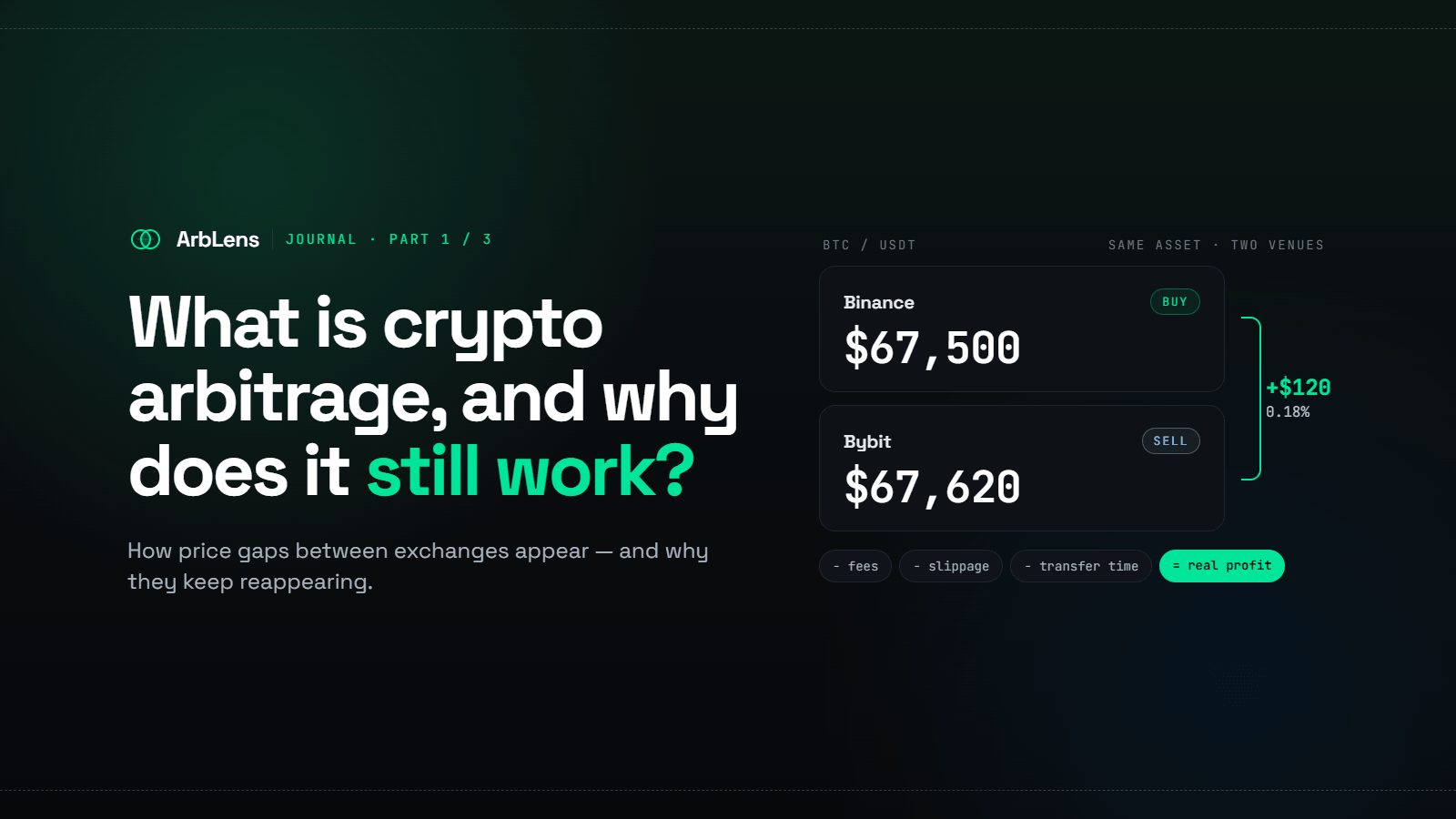
BTC at $67,500 on Binance. $67,620 on Bybit. A $120 gap, about 0.18%. Buy on Binance, sell on Bybit at the same moment, and you keep the spread minus both exchanges' fees.
Note: real profit is always smaller than that quoted spread. Fees eat into it. So does slippage. So does the time it takes to actually move funds across.
Why arbitrage hasn't been competed away
Traditional finance closes these gaps in milliseconds — high-frequency firms see it and act faster than any person could. Crypto is different. It runs 24/7. There isn't a handful of major venues, there are hundreds, and a lot of them are thin on liquidity. Moving funds between exchanges takes minutes at best, hours at worst, depending on the chain. New gaps keep opening faster than they close.
Running a book across several exchanges brings its own headache, separate from finding the spread. Where's your capital right now? Balances split across venues. Positions open on both legs of a trade. Funding accruing quietly, in the background, while you're not looking. Miss any one piece and a profitable trade turns into a break-even one without anyone noticing until the numbers don't add up. ArbLens pulls balances, positions, PnL, fills, and funding across supported exchanges and wallets into one dashboard. It won't find the arbitrage for you. It just stops you from losing track of it once you're already in the trade.
Key takeaways
Arbitrage: capture the price gap for the same asset across two markets
In crypto, that gap comes from fragmentation — hundreds of independent exchanges, no shared price
Real profit = spread minus fees, slippage, transfer time
Crypto arbitrage survives mainly because the market never sleeps and moving capital between venues still takes real time