Pump-and-dump risk: honeypots, rug pulls, and failed exits
Pump trades fail when liquidity vanishes or selling is blocked. Learn how to spot manipulation, honeypots, rug pulls, and sizing mistakes before entry.
Part 3 of a three-part series on sudden crypto price moves.
Trading sharp price moves can produce fast gains. It can also leave a trader holding a token that cannot be sold.
The danger is not limited to choosing the wrong direction. During a manipulated pump or a DEX exploit, the quoted price may stop meaning anything. Liquidity can disappear, sell transactions can fail, and a stop-loss may never execute.
Treat every unusual move as an investigation first.
How a pump-and-dump scheme works
A coordinated group starts by accumulating an illiquid token. Organizers may build their positions slowly to avoid moving the price too early.
They then promote the token and begin buying more aggressively. The price rises because the order book or DEX pool is thin.
Public messages appear after the move has started:
"Buy now"
"Next 100x"
"Major announcement coming"
Countdown posts in Telegram or Discord
Screenshots showing early profits
New traders arrive and provide the liquidity organizers need to sell. Once that selling begins, the same thin market that helped the price rise causes it to collapse.
Late buyers are not participating in the pump. They are financing the exit.
Warning signs of coordinated manipulation
No single indicator proves that a move is manipulated.
Several signals appearing together deserve attention:
A sharp rise without verifiable news
Low liquidity relative to the reported market capitalization
Most volume concentrated on one venue
A sudden burst of nearly identical social posts
Calls to buy at a specific time
Large holdings controlled by a few related wallets
Repeated market buys followed by large transfers to the pool or exchange
A price move unsupported by other active markets
A token can move without public news for legitimate reasons. On-chain traders may discover information before an announcement. The point is to verify the move rather than assume every green candle is organic.
Why buying after the alert is dangerous
By the time a pump appears on a public leaderboard, much of the move may already be over.
The percentage gain attracts attention, but it says nothing about remaining buyers. A token up 200% can rise further. It can also lose most of its value on the next transaction.
Buying because another venue or social channel shows a pump is a directional trade. There is no locked profit.
Check whether an executable sell exists before entering. If the plan is simply "someone else will buy higher," the position depends on finding a later buyer.
Honeypot tokens
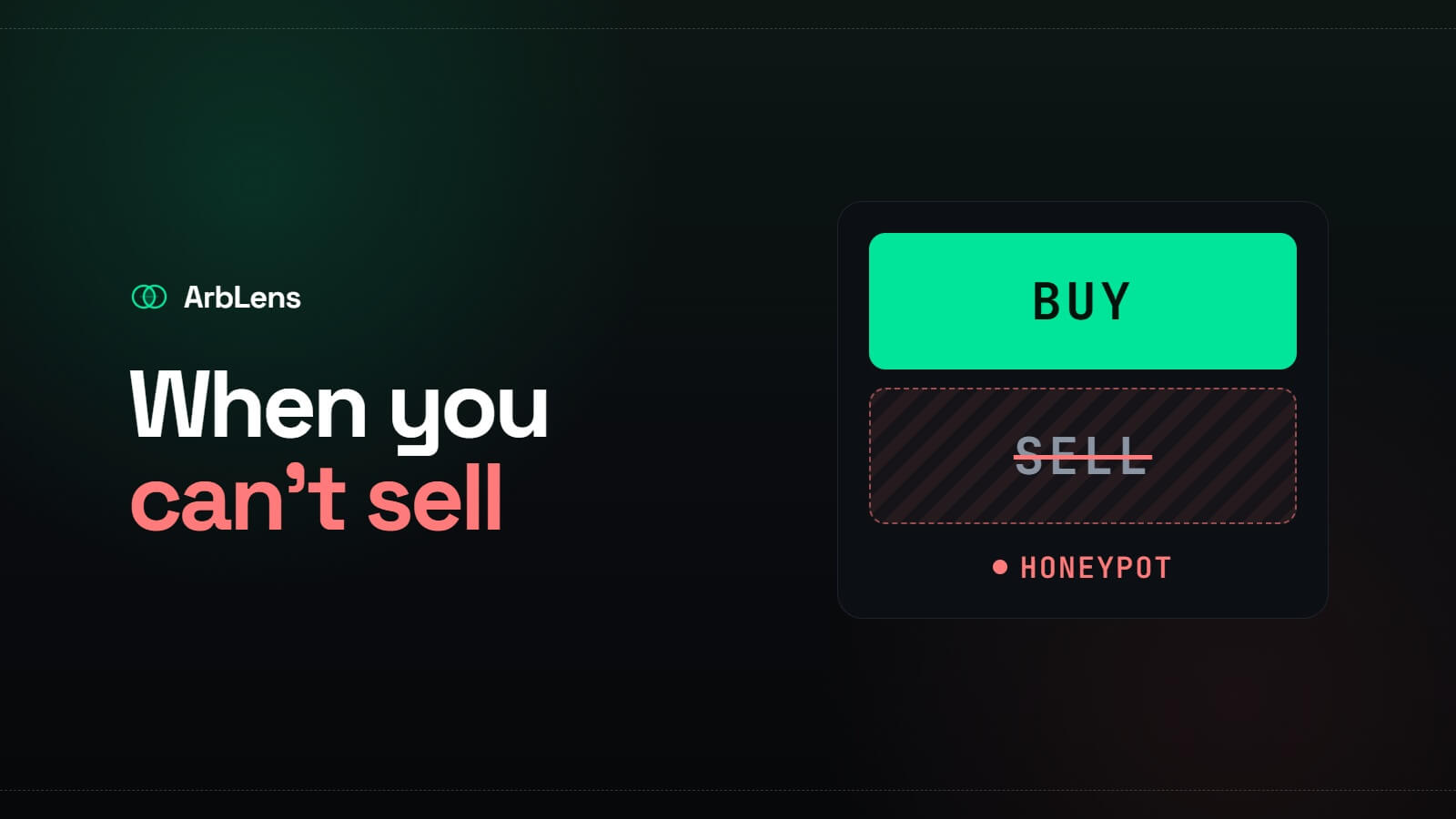
A honeypot allows purchases while blocking or heavily penalizing sales.
The restriction can be built into the token contract in several ways:
Only approved addresses may sell
The owner can blacklist wallets
Sell tax rises to an extreme level
Maximum transaction size becomes too small to exit
Transfers to the liquidity pool are blocked
Trading rules change after a wallet buys
A proxy contract is upgraded with new restrictions
The chart may continue rising because buyers can enter but ordinary holders cannot leave.
A quoted price in this market is largely fictional. It reflects purchases without a functioning sell side.
Contract scanners are not guarantees
Automated contract checks can detect common honeypot patterns, suspicious permissions, and simulated sell failures.
They can miss contracts that behave differently by wallet, block number, trade size, or transaction route. An owner may also change taxes or blacklist addresses after the scan.
A successful test sale does not prove that future sales will remain possible.
Use automated checks as one layer. Inspect ownership, proxy controls, tax settings, mint permissions, and recent contract changes as well.
No scanner can guarantee that a token is safe.
Rug pulls
A rug pull occurs when people controlling a project extract value from traders, often by removing liquidity or selling a concentrated token allocation.
If most paired liquidity is withdrawn, holders may still own tokens but have no market in which to sell them.
The price does not always fall neatly to zero. A tiny amount of remaining liquidity can produce misleading quotes and extreme chart movements.
Check:
Who controls the liquidity-provider position
Whether liquidity is locked
Lock duration and unlock date
Whether the owner can migrate the pool
Token concentration among top holders
Minting permissions
Upgradeable contract controls
Team and treasury wallet activity
Locked liquidity helps, but it is not a complete safety check. A team may still mint tokens, change transfer taxes, upgrade the contract, or sell a large allocation into the pool.
Liquidity matters more than market capitalization
Market capitalization is usually calculated from the latest price multiplied by token supply.
For a thin token, one small purchase can raise the latest price and create a large reported market cap. That does not mean similar value can be sold.
Pool liquidity shows how much capital is available for actual swaps. Even that number needs context. Much of the liquidity may sit outside the active price range in a concentrated-liquidity pool.
Request sell quotes for realistic position sizes. Compare the expected output with the headline price.
Stop-loss orders may not protect you
A stop-loss works only when an order can be submitted and filled.
On a DEX, the price may move past the trigger before the transaction confirms. Gas may spike, the swap may revert, or the pool may lose its liquidity. A honeypot contract can block the sale entirely.
Wide slippage settings may force an exit, but they also expose the trade to a much worse fill and possible MEV.
Use a stop as part of the plan, not as proof that the maximum loss is controlled.
Position sizing should assume a failed exit
There is no universal rule that 2–5% of capital is safe for every pump trade.
A 5% position that cannot be sold can lose the full 5%. Several correlated trades can fail at the same time.
Size the position from the amount you can afford to lose if:
The token falls to zero
The sell transaction fails
Liquidity is removed
The contract changes
The wallet or approval is compromised
For unknown DEX tokens, total loss is a realistic stress test.
A small test transaction can reveal obvious problems. It does not replace a position limit.
Alerts are for investigation
Early alerts are useful because they reduce reaction time. They also produce false positives.
A good alert should include:
Token and contract address
DEX and pool
Price change and time window
Transaction that caused the move
Pool liquidity before and after
Trade size
Holder concentration
Prices on other markets
Contract-risk indicators
A percentage change without this context is mostly noise.
The faster the alert arrives, the less information may be available. Do not confuse early detection with certainty.
A pre-trade check
Before buying a token after a pump or dump, confirm:
The contract address is correct.
The active pool has usable liquidity.
A realistic sell quote exists.
Contract permissions have been reviewed.
No unexpected minting or liquidity removal occurred.
Large-wallet activity has been checked.
The move appears on more than one credible market.
The news or event behind the move can be verified.
Maximum loss and exit conditions are set.
The position remains acceptable if it cannot be sold.
If those checks cannot be completed quickly, skipping the trade is a valid decision.
Manipulated markets reward the earliest organizers, not the traders who react to the loudest alert.