Prediction-market arbitrage: risk management beyond the locked payout
Prediction-market arbitrage can lock the payout while leaving execution, settlement, liquidity, and platform risk. Learn how to size and compare trades
Part 4 of a four-part series on prediction-market arbitrage.
Prediction-market arbitrage can remove uncertainty about the event itself. It cannot remove execution, settlement, platform, or liquidity risk.
If complementary contracts cost less than their combined payout, the final result does not depend on who wins an election or where BTC finishes the year. That payout is locked only after both legs fill in matching size and the contracts are confirmed to resolve consistently.
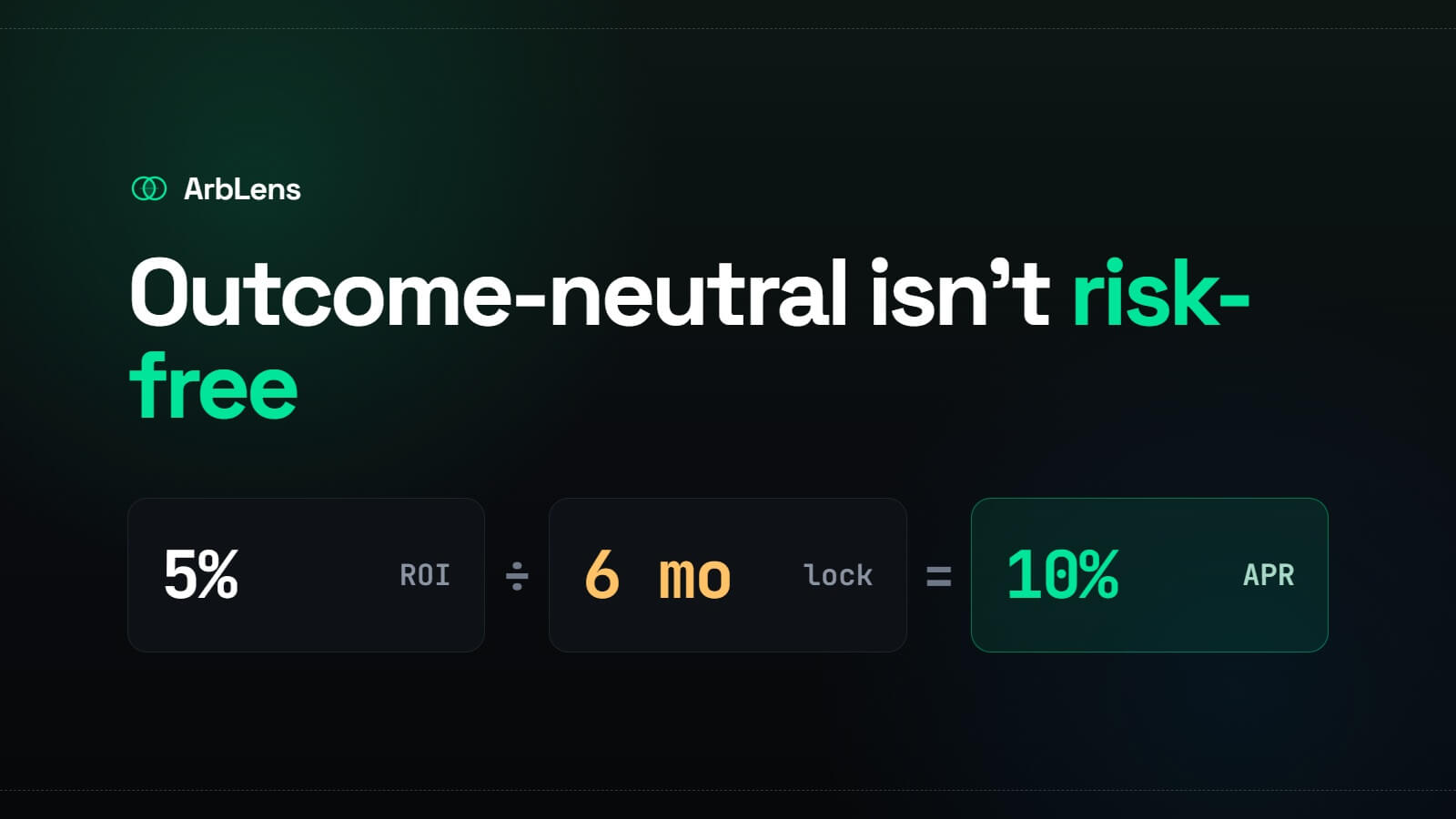
Outcome-neutral is a better description than risk-free.
Liquidity limits the trade
A prediction market can show an attractive price without offering much size.
The best ask may cover only a few shares. A larger order then moves through the book and raises the average purchase price. If the second leg is thinner, the apparent arbitrage can disappear before the position is complete.
Twenty-four-hour volume is useful as an activity filter. It does not show what can be filled now.
Check:
Executable asks for both outcomes
Available quantity at each price level
Average fill price for the full position
Recent trade frequency
Depth available if the position must be closed early
The smaller side determines the maximum matched position.
Partial fills create event exposure
Suppose you buy 1,000 YES shares but can obtain only 600 NO shares at the expected price.
Only 600 pairs are hedged. The remaining 400 YES shares are a directional position on the event.
This is the main execution risk in complete-set arbitrage. The trade looks locked in a table but becomes speculative when one leg fills without the other.
Before entering, define:
Maximum acceptable combined cost
Maximum unmatched quantity
Time allowed to complete the second leg
Price limit for both orders
Plan for closing a partial fill
A wider spread can justify some execution effort. It does not justify an unlimited price on the second leg.
Daily volume thresholds are unreliable
A rule such as "trade only markets above $10,000 in daily volume" can remove obviously inactive contracts. It should not determine position size.
A market may report more than $10,000 in volume while offering little depth at the current prices. Another market may have lower historical volume but a market maker quoting both sides.
Use volume to narrow the list. Use the live order book to size the trade.
Popular topics can also be deceptive. An election market may have high total volume, but a specific outcome or expiry can still be thin.
Time to settlement changes the return
Prediction contracts usually pay only after the event resolves and the result is confirmed.
A 5% return locked for six months is roughly a 10% simple APR:
5%×126=10%5\%\times\frac{12}{6}=10\%5%×612=10%
That comparison assumes the capital remains tied up for the full period.
A market resolving in one week may offer a smaller absolute return but recycle capital sooner. A long-dated market may justify a larger spread because it locks funds for months and leaves more time for disputes or platform changes.
Shorter expiry is not automatically better. A near-term contract with thin liquidity or ambiguous rules can still be a poor trade.
Compare:
Simple APR=Net ROI×365Days to expected settlement\text{Simple APR} = \text{Net ROI} \times \frac{365}{\text{Days to expected settlement}}Simple APR=Net ROI×Days to expected settlement365
Use the expected settlement date, not just the event date. Resolution and redemption may take additional time.
Fees differ by platform and market
Fee models are not uniform.
An on-chain platform may involve trading fees on certain markets, network costs, and fees charged by deposit or withdrawal providers. Another platform may calculate transaction fees from contract price, quantity, and order type.
Do not rely on a single percentage for every market.
The net result is:
Net profit=Combined payout−Cost of both legs−Trading fees−Network costs−Deposit and withdrawal costs−Currency conversion\begin{aligned} \text{Net profit} ={}& \text{Combined payout} - \text{Cost of both legs} \\ &- \text{Trading fees} - \text{Network costs} \\ &- \text{Deposit and withdrawal costs} - \text{Currency conversion} \end{aligned}Net profit=Combined payout−Cost of both legs−Trading fees−Network costs−Deposit and withdrawal costs−Currency conversion
Fees may apply at entry, exit, or settlement. Check the current schedule for the exact contract.
Settlement risk starts with the wording
A prediction-market position pays according to the written rules, not the common understanding of the event.
Two platforms may disagree without either making an error. They may use different deadlines, timezones, data sources, or definitions.
Read:
The full resolution criteria
Primary and fallback data sources
Rules for delays and cancellations
Invalid-market treatment
Dispute and appeal procedures
Expected settlement timeline
A direct arbitrage trade fails if both supposedly complementary contracts resolve YES or both resolve NO under their respective rules.
This risk cannot be fixed by position sizing. The contracts must be rejected as a pair.
Ambiguous events need a larger margin of safety
Some questions resolve cleanly. A published inflation figure or official election result has a named source and a specific release.
Other events depend on interpretation. Terms such as "launch," "agreement," "officially announced," or "controls" may require judgment.
A two-cent spread is poor compensation for a contract whose wording can support several interpretations.
When resolution is subjective, either demand a wider net return or skip the trade.
Platform risk remains
Capital sits with or depends on the platform until it can be withdrawn.
Possible problems include:
Account restrictions
Delayed withdrawals
Smart-contract failures
Operational outages
Regulatory changes
Disputed settlements
Platform insolvency or closure
Holding several event positions on one platform does not diversify platform risk. All of them depend on the same infrastructure and withdrawal process.
Spread exposure across venues only when the extra accounts and transfer costs are manageable. Diversification that cannot be monitored creates its own operational risk.
Stablecoin and currency risk
Cross-platform trades may use different settlement assets.
One venue may settle in dollars, while another uses a stablecoin. Treating both as exactly equal ignores conversion costs, withdrawal limits, and the possibility that the stablecoin moves away from its peg.
The risk may be small relative to the spread. It still belongs in the calculation.
Use the amount that can be withdrawn and converted, not the balance shown before fees.
Set position limits by failure mode
A flat percentage of total capital is easy to follow but does not capture the actual risk.
Position size should reflect:
Liquidity on the weaker leg
Maximum loss from a partial fill
Time until settlement
Platform concentration
Resolution ambiguity
Capital needed for other opportunities
Limit exposure to each platform as well as each event. A portfolio of ten markets on one venue is still concentrated if withdrawals stop.
Keep some capital uncommitted. Prediction-market opportunities often appear around breaking news, and locked contracts cannot always be sold without giving up the edge.
There is no universal 2% minimum
A rule that rejects every net spread below 2% is too crude.
A 1% return settling tomorrow in a deep, clearly defined market may be more attractive than a 6% return locked for nine months. The larger spread may also carry worse liquidity and more settlement risk.
Compare the trade on four dimensions:
Net ROI after all costs
Annualized return
Capital lockup
Failure risk
Operational effort matters too. A small spread may not justify maintaining another funded account or monitoring a disputed event for months.
Final pre-trade check
Before calling the position arbitrage, confirm:
Both contracts describe complementary outcomes.
Deadlines, timezones, and sources match.
Both legs can fill in equal quantity.
Combined executable cost is below the payout.
All fees are included.
Settlement time is acceptable.
Exposure fits the platform and event limits.
There is a plan for partial fills and early exit.
Only the event outcome is neutralized. Everything around the trade still needs managing.