Tokenized-equity arbitrage: what you are actually trading
Tokenized-equity arbitrage trades price gaps across crypto venues. Learn how backing, trading hours, liquidity, and settlement terms change the trade.
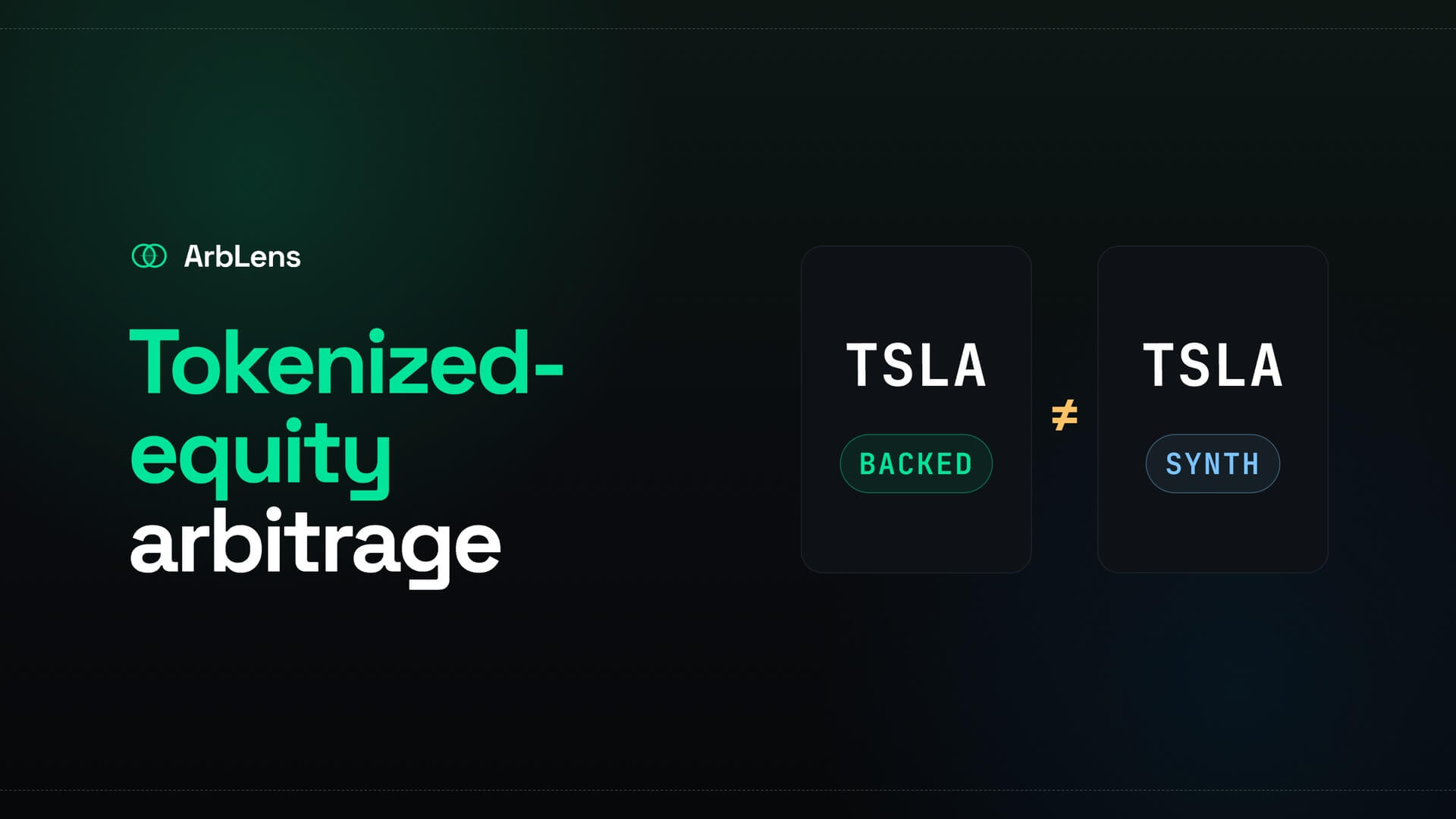
Part 1 of a three-part series on tokenized-equity arbitrage.
Tokenized-equity arbitrage targets price differences between stock-linked products traded on crypto platforms.
A token referencing Apple or Tesla may trade at different prices across two venues. That does not automatically create a usable arbitrage. Before comparing quotes, you need to know whether the products represent the same asset, whether they can be transferred or redeemed, and what rights they provide.
The ticker is only the label.
What is a tokenized equity?
A tokenized equity is a blockchain-based asset whose value is linked to a publicly traded stock or ETF.
The structure varies. One token may be backed by shares held through a custodian. Another may provide synthetic price exposure without giving the holder ownership of the underlying stock. A third platform may offer a conventional brokerage product or futures contract inside a crypto-style interface.
Those are different instruments.
Bybit, for example, lists xStocks, which are tokenized representations of U.S. stocks and ETFs. MEXC offers stock-related products through RealStocks and stock futures. A brokered share, a backed token, and a futures contract should not be treated as interchangeable simply because they reference the same company.
Read the product terms before comparing prices.
What does the token holder own?
Some tokenized products are backed by shares held by an issuer or custodian. Others are derivatives that track a reference price.
The distinction affects:
Redemption into the underlying share
Dividend treatment
Voting and shareholder rights
Counterparty exposure
Transferability between wallets or platforms
Treatment of stock splits and other corporate actions
A token can follow Apple’s share price without making its holder an Apple shareholder.
The issuer also matters. Two tokens linked to the same stock may have different custodians, collateral, jurisdictions, and redemption rules. A discount on one may reflect those differences rather than a temporary pricing error.
Trading may not be available everywhere
Tokenized equities are often marketed as a way to access stock exposure outside a traditional brokerage account.
That does not remove legal or regional restrictions.
Availability depends on the platform, product, and user’s jurisdiction. KYC may be required. Some countries may be excluded, and trading or transfers may be limited to approved users.
Trading hours vary too. Certain tokenized products trade around the clock, while others follow the schedule of the underlying stock market or pause during specific periods.
Check the actual market rules rather than assuming every stock token trades 24/7.
Why prices diverge
Each venue has its own buyers, sellers, and liquidity.
A tokenized Apple product may have a deep book on one platform and almost no activity on another. A modest order can move the thinner market without affecting the other venue.
Pricing sources can differ as well. One platform may use a consolidated U.S. equity feed, while another relies on an issuer’s reference price or its own market makers.
Gaps are more likely when the underlying stock market is closed. There is no live primary-market price to anchor the token, so crypto traders price overnight news and expected moves among themselves.
Other causes include:
Different trading hours
Thin order books
Delayed price updates
Restricted deposits or withdrawals
Limited redemption
Corporate actions handled on different schedules
A persistent gap may signal friction rather than free profit.
When the trade is genuine arbitrage
The cleanest setup uses the same transferable token on two venues.
If the token trades cheaper on one exchange, a trader can buy it there and sell existing inventory where it trades higher. The position can later be rebalanced by transferring the token back, assuming both venues support the same contract and network.
The trade resembles spot-to-spot crypto arbitrage:
Keep quote currency on the cheaper venue.
Keep token inventory on the more expensive venue.
Buy and sell the same amount.
Confirm both fills.
Rebalance after accounting for transfer costs and restrictions.
Pre-funded inventory matters. Waiting to transfer the token after noticing the gap gives the market time to close it.
Similar products may not converge
Suppose two venues list products tied to Tesla. One is a transferable, share-backed token. The other is a synthetic contract settled in USDT.
Buying the first and selling the second creates a hedge, but not a locked transfer arbitrage. You cannot move one product to the other venue and deliver it against the sale.
The prices may converge because they reference the same stock. They do not have to converge on your schedule.
The trade now carries basis risk, funding or borrowing costs, and the possibility that one issuer changes its rules. It should be treated more like relative-value trading than simple spot arbitrage.
Selling the expensive side may be difficult
An arbitrage trade needs both legs.
Buying the discounted token is usually straightforward. Selling the expensive product may require existing inventory, spot borrowing, or access to a derivative that can be shorted.
If shorting is unavailable and the token cannot be transferred between venues, the displayed gap may not be tradable. You can buy the cheaper side, but you cannot lock in the sale.
That is a directional position.
Before entering, confirm how the expensive leg will be executed and closed.
Calculate the net return
The visible spread is gross. A practical estimate includes:
$$\begin{aligned} \text{Net PnL} ={}& \text{Sale proceeds} - \text{Purchase cost} \\ &- \text{Trading fees} - \text{Slippage} \\ &- \text{Transfer or redemption costs} - \text{Borrowing or funding costs} \end{aligned}$$
If the products are not transferable, include the risk that the basis widens before both positions can be closed.
Currency conversion may matter too. A stock token quoted in USDT and a reference market quoted in USD do not use exactly the same unit of account when the stablecoin moves away from its peg.
Check the underlying market session
A large weekend spread may look attractive because the tokenized market is open while the underlying stock exchange is closed.
There is no live stock price to prove which venue is wrong.
When the equity market reopens, the underlying share may move toward the token price rather than the other way around. Weekend and overnight gaps therefore include event risk.
Earnings, regulatory news, acquisitions, and macro announcements can all change the expected opening price.
The lack of a live reference makes the spread harder to value, not easier.
What to verify before trading
Confirm the product structure on both venues:
Same issuer and token contract
Backing and custody arrangement
Trading schedule
Deposit and withdrawal support
Redemption process
Dividend and corporate-action policy
Available depth at the intended size
Ability to sell or short the expensive side
Only then calculate the spread.
Tokenized-equity markets can be less efficient than major crypto pairs, and their spreads may be wider. Much of that spread pays for product differences, restricted access, and weaker liquidity. The part left after those costs is the actual arbitrage opportunity.