Spread, depth, and volume: how to read an arbitrage table
A spread is only the headline. Learn how order-book depth, trade size, 24-hour volume, slippage, and transfer status determine whether an arbitrage is tradable.
Spread, depth, and volume: how to read an arbitrage table
Part 2 of a four-part series on spot-to-spot arbitrage.
Excerpt: A spread is only the headline. Learn how order-book depth, trade size, 24-hour volume, slippage, and transfer status determine whether an arbitrage is tradable.
Tags: arbitrage, spreads, liquidity, volume, slippage
A large spread catches the eye. It doesn't tell you whether the trade will work.
Before placing an order, you need to check how the spread was calculated, how much liquidity sits near the quoted prices, and whether funds can move between the two venues. A scanner table is useful only if you can read the rest of the row.
Spread is the starting point
The spread is the percentage difference between the buy price on one exchange and the sell price on another.
A simple calculation looks like this:
$$\text{Gross spread} = \frac{\text{Sell price} - \text{Buy price}}{\text{Buy price}} \times 100$$
This is the gross spread. It does not account for trading fees, slippage, or transfer costs.
As a rough filter:
0.1–0.3% may disappear after fees, especially on heavily traded pairs
0.3–1% can be worth checking, but only after estimating both fills
Above 1% deserves extra scrutiny rather than automatic excitement
An unusually wide gap often has an explanation. The order book may be thin. Deposits or withdrawals may be suspended. The scanner may be showing stale data, or the quoted price may apply to a very small order.
The wider the spread, the more carefully you should inspect it.
Volume shows activity, not available liquidity
A table may show the market's trading volume over the past 24 hours. This helps distinguish an active pair from one that barely trades.
It doesn't tell you how much you can buy or sell right now.
A market can report high daily volume and still have little liquidity near the current price. Most of that volume may have traded hours earlier or at different price levels.
The common rule that a position should stay below 1–2% of daily volume is, at best, a rough ceiling. It is not a safe sizing method. Even 1% of reported volume can be far too large if the book is thin.
For execution, current order-book depth matters more.
Depth tells you what the spread is worth
The top ask shows the cheapest available sell order. The top bid shows the highest available buy order. Those prices may cover only a small amount.
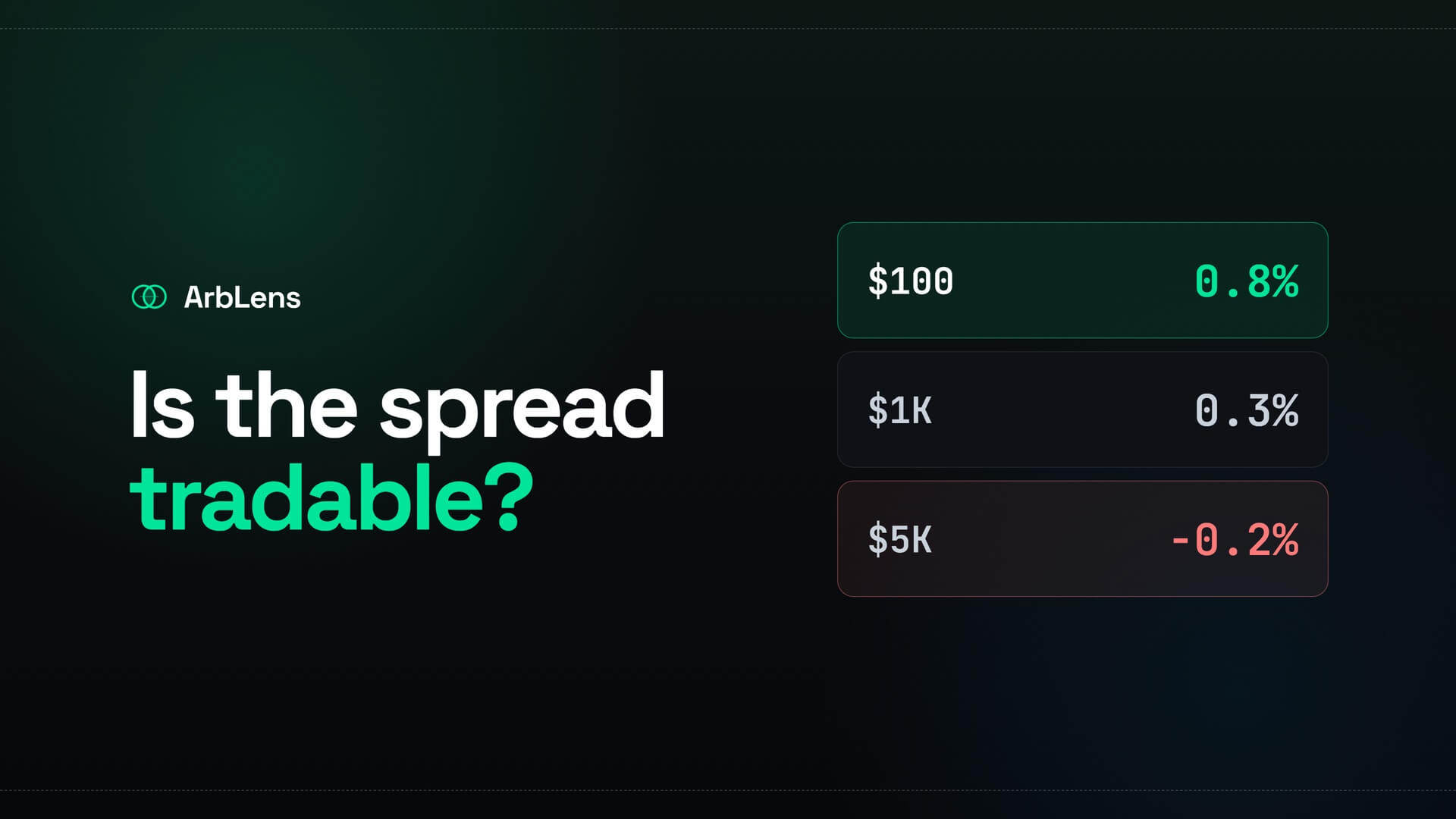
Suppose a scanner displays a 0.8% spread. If there is enough liquidity for only $100 at those prices, a $5,000 order will move through several levels of the book. Your average buy price rises. Your average sell price falls.
The displayed spread shrinks as the orders fill. That is slippage.
Check cumulative depth on both sides:
How much can you buy before the price moves by 0.1%?
How much can you sell within the same range?
What are the estimated average fill prices for your full size?
Does the net spread remain positive after fees?
The smaller side sets the maximum practical trade size. Deep liquidity on the buy side doesn't help if the sell side can absorb only a fraction of the order.
Trade size should come from the book
Don't size the position from the headline spread or the 24-hour volume alone.
Start with the amount available inside your chosen slippage limit. Then compare the expected average buy and sell prices. Subtract fees from both legs.
The useful number is the net spread at your intended size:
$$Net spread=Gross spread−Buy fee−Sell fee−Slippage$$
If funds must be moved afterward, include the withdrawal and network costs as well.
A smaller trade with a clean fill can produce a better result than a larger trade that consumes the book.
Deposit and withdrawal status changes the trade
A suspended network doesn't always prevent a pre-funded arbitrage trade. You may still be able to buy on one venue and sell existing inventory on the other.
It does prevent normal rebalancing.
If withdrawals are disabled on the exchange where you bought the asset, the new inventory may be stuck there. If deposits are disabled on the other venue, you can't move the asset across to restore the original balances.
Check the status of the exact network you plan to use. A token may be available on several chains while one of them is paused.
For any trade that depends on moving funds first, a disabled deposit or withdrawal means the opportunity isn't executable.
Filters reduce noise
A useful scanner setup filters out pairs that don't meet your minimum requirements. You might filter by gross spread, order-book depth, trading volume, or transfer status.
Alerts save time, but they aren't trading signals. An alert means the row is worth checking. It doesn't mean the displayed profit is available at your size.
A scanner shows where prices differ. It doesn't show whether your capital is ready for both legs. ArbLens tracks available and locked balances across supported exchanges and wallets, along with fills and transfer history. Used together, the two views answer different questions: where the gap is, and whether you can trade it without waiting for funds to move.