Spot-futures arbitrage: how cash-and-carry trades work
Spot-futures arbitrage pairs a spot purchase with a futures short. Learn how basis convergence, funding, fees, and liquidation risk affect the trade.
Part 3 of a four-part series on spot-to-spot arbitrage.
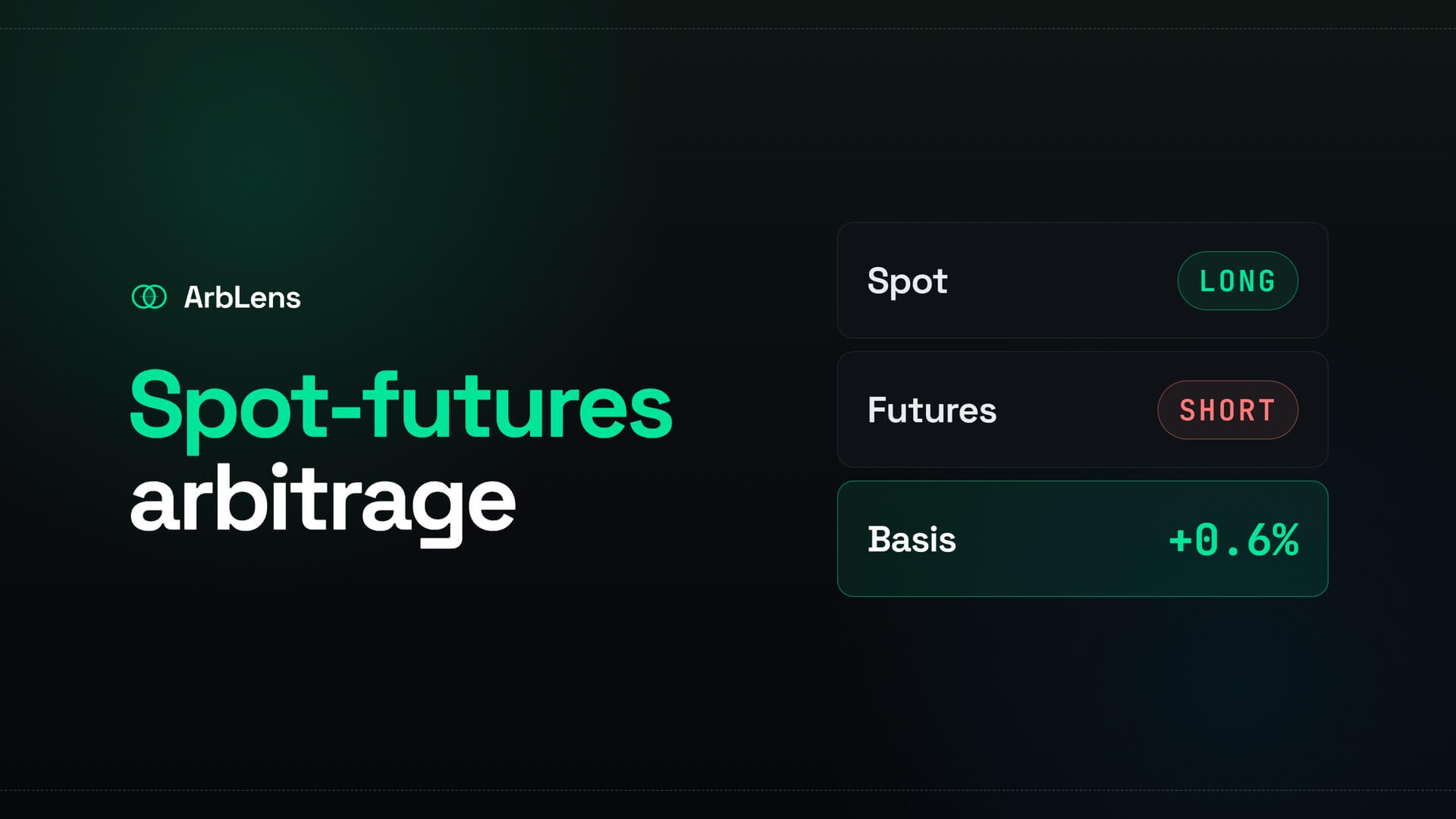
Spot-futures arbitrage trades the gap between an asset’s spot price and its futures price. The standard setup is simple: buy the asset on spot and short an equal amount through a futures contract.
Traders often call this a cash-and-carry trade.
The two legs offset most of the position’s directional exposure. Profit comes from the basis narrowing, not from guessing whether the asset will rise or fall.
What the basis tells you
The basis is the difference between the futures and spot prices:
Basis=Futures price−Spot price\text{Basis} = \text{Futures price} - \text{Spot price}Basis=Futures price−Spot price
It can also be shown as a percentage:
Basis %=Futures price−Spot priceSpot price×100\text{Basis \%} = \frac{\text{Futures price} - \text{Spot price}} {\text{Spot price}} \times 100Basis %=Spot priceFutures price−Spot price×100
When futures trade above spot, the market is in contango. A trader can buy spot and short futures, locking in the gap if both legs fill at the expected prices.
Futures do not always trade above spot. They can also trade below it, a condition known as backwardation.
Dated futures and perpetuals behave differently
The type of futures contract changes how the trade works.
A dated futures contract has an expiry. Its price should converge toward the contract’s settlement index as expiration approaches. A trader holding a matched spot-long and futures-short position can close both legs when the basis narrows or hold until settlement.
Perpetual futures have no expiry. Their price is kept near spot through funding payments, so there is no fixed date when the spread must close.
That distinction matters. With a dated contract, the expiry creates a defined settlement point. With a perpetual, the trade may remain open while funding keeps changing.
How the trade is opened
The basic workflow looks like this:
Buy the asset on the spot market.
Short the same asset through a futures contract.
Match the notional size of the two legs.
Wait for the basis to narrow.
Close both positions as close together as possible.
Suppose you buy 1 ETH on spot. The futures short should represent roughly 1 ETH as well. If the sizes differ, the leftover amount becomes a directional position.
Contract specifications need checking too. Linear and inverse futures do not behave in exactly the same way, and a contract’s multiplier may affect the correct hedge size.
Hedged does not mean risk-free
If ETH rises, the spot position gains while the futures short loses. If ETH falls, the opposite happens. A properly sized hedge therefore removes much of the outright price exposure.
It does not remove every risk.
The futures leg still uses margin. A sharp move can bring it close to liquidation even while the spot leg shows an offsetting profit elsewhere. Unless collateral can be moved quickly, the profitable leg may not save the losing one.
The basis can also widen before it narrows. That may create an unrealized loss and increase margin pressure, particularly when leverage is high.
Other costs remain:
Trading fees on entry and exit
Slippage on both legs
Funding payments on perpetuals
Borrowing or margin costs
Settlement and counterparty risk
Transfer costs when collateral needs rebalancing
The expected basis has to cover all of them.
Funding can help or hurt
Perpetual contracts exchange funding payments between longs and shorts. When funding is positive, longs pay shorts. That benefits the short leg of a cash-and-carry position.
When funding turns negative, shorts pay longs. The same trade now carries a recurring cost.
Funding is often exchanged every eight hours, but that schedule is not universal. The interval and calculation method depend on the venue and contract.
A displayed funding rate is not guaranteed for the life of the trade. It can change before the next payment and may reverse while the position remains open. Expected funding should therefore be treated as variable, not locked profit.
What happens when the basis is negative
Sometimes futures trade below spot. Simply buying the futures contract and waiting for the gap to close is not a hedged arbitrage trade. It leaves the trader exposed to the asset’s price.
A true reverse cash-and-carry trade requires the opposite legs: short the asset on spot and go long futures. That usually means borrowing the asset, which adds borrowing costs, availability limits, and the risk of a recall or rising interest rate.
If spot borrowing is unavailable or too expensive, the negative basis may not be tradable as arbitrage.
Closing the position
The two legs should be closed together. Closing only one side turns the remaining leg into a directional trade.
Before exiting, calculate the actual result rather than looking only at the change in basis:
Net PnL=Spot PnL+Futures PnL+Funding−Fees−Slippage\text{Net PnL} = \text{Spot PnL} + \text{Futures PnL} + \text{Funding} - \text{Fees} - \text{Slippage}Net PnL=Spot PnL+Futures PnL+Funding−Fees−Slippage
For dated futures held to expiry, settlement mechanics also need to be included. For perpetuals, funding may account for a meaningful share of the final return.
What to check before entering
Confirm that the spot asset and futures contract track the same underlying market. Match the notional size of both legs and leave enough collateral to withstand a wider basis.
Then check the less obvious costs:
Entry and exit fees
Expected fill prices at your size
Current funding and its payment schedule
Liquidation distance on the futures leg
Capital required on each venue
The conditions for closing or settling the trade
Managing both legs becomes harder when spot inventory and futures margin sit on different exchanges. ArbLens pairs long and short positions across supported venues and tracks their spread, funding, liquidation distance, and net PnL. It does not open or close the trade. It keeps the two legs visible as one position.