Prediction markets: contracts, prices, and settlement
Prediction markets turn event outcomes into tradable contracts. Learn how prices imply odds, how settlement works, and where apparent arbitrage can mislead.
Part 1 of a four-part series on prediction-market arbitrage.
Prediction markets turn uncertain events into tradable contracts.
Markets can cover elections, economic data, crypto prices, sports, weather, and other measurable outcomes. Traders buy and sell contracts based on how likely they think each outcome is.
A price of $0.60 is often read as an implied probability of roughly 60%. It is a market price, though, not an objective forecast. Liquidity, fees, trader preferences, and position limits can all affect it.
The main prediction-market platforms
Polymarket is a crypto-native prediction market with on-chain positions and an order-book trading model. It covers politics, crypto, economics, sports, and current events.
Kalshi operates as a CFTC-regulated Designated Contract Market in the United States. Its event contracts settle in dollars, and access depends on its account and jurisdiction rules.
Limitless is an on-chain prediction market built on Base. It lists markets across crypto, politics, sports, and other events.
The platforms may list similar questions, but their contracts are not automatically interchangeable. Each venue sets its own wording, deadline, data source, and settlement procedure.
How a binary contract works
A binary market has two outcomes: YES and NO.
Each winning share normally pays $1 when the market resolves. The losing side pays nothing.
Prices trade between $0 and $1. If YES is available at $0.60, the market is often described as assigning a 60% implied probability to the event.
Buying YES at $0.60 produces two possible outcomes:
The market resolves YES, and the share pays $1
The market resolves NO, and the share becomes worthless
The price can move before settlement, so traders do not always hold until resolution. A YES share bought at $0.60 might be sold at $0.75 if the market moves in the trader’s favor.
Not every market is binary
Some prediction markets have several possible outcomes.
An election market may list one contract for each candidate. An economic market may use ranges, such as whether an inflation reading will fall below 2%, between 2% and 3%, or above 3%.
The combined outcome set should cover the resolution possibilities defined by the market. Before trading, check whether outcomes are mutually exclusive and collectively exhaustive.
A missing or overlapping outcome can change the economics of an apparent arbitrage.
A simple contract example
Consider the question:
Will BTC trade above $100,000 before the end of the year?
Suppose YES shares cost $0.45.
If the contract resolves YES, each share pays $1. The gross profit is $0.55 per share before fees.
If the contract resolves NO, the $0.45 purchase is lost.
The important details are hidden in the market rules:
What does "trade above" mean?
Which exchange or price index is used?
Does one trade above $100,000 count?
What is the exact deadline and timezone?
What happens if the data source is unavailable?
Two platforms can display the same headline question while using different answers to those questions.
Price is an implied probability, not a fact
A $0.60 price is commonly translated into a 60% probability because a winning contract pays $1.
That interpretation works as a shorthand. It does not mean the event has been measured with scientific precision.
The displayed price may be the midpoint between a bid and ask rather than an executable quote. A thin market can move sharply after one small order. Large traders may also demand compensation for locking up capital until settlement.
Use the live order book when evaluating a trade. The headline probability may not be available at your intended size.
How contracts settle
Every market needs a resolution rule and a source of truth.
A political market might use a government announcement. A crypto market may rely on a named price index. An economic contract could use a specific release from a statistical agency.
When the result becomes final, winning shares can be redeemed for the contract payout.
Settlement may not happen immediately after the real-world event. The platform may wait for official confirmation, handle disputes, or apply rules for ambiguous outcomes.
Capital remains tied up during that process.
Why platform prices differ
Each platform has its own users and liquidity.
One market may attract traders who follow U.S. politics closely, while another has more crypto-native flow. Account restrictions can also prevent the same traders from using both venues.
Prices may diverge because of:
Different contract wording
Different settlement sources
Separate order books
Regional access restrictions
Deposit and withdrawal friction
Fees and position limits
Different market closing times
Some differences are temporary. Others reflect genuinely different contracts.
Cross-platform arbitrage
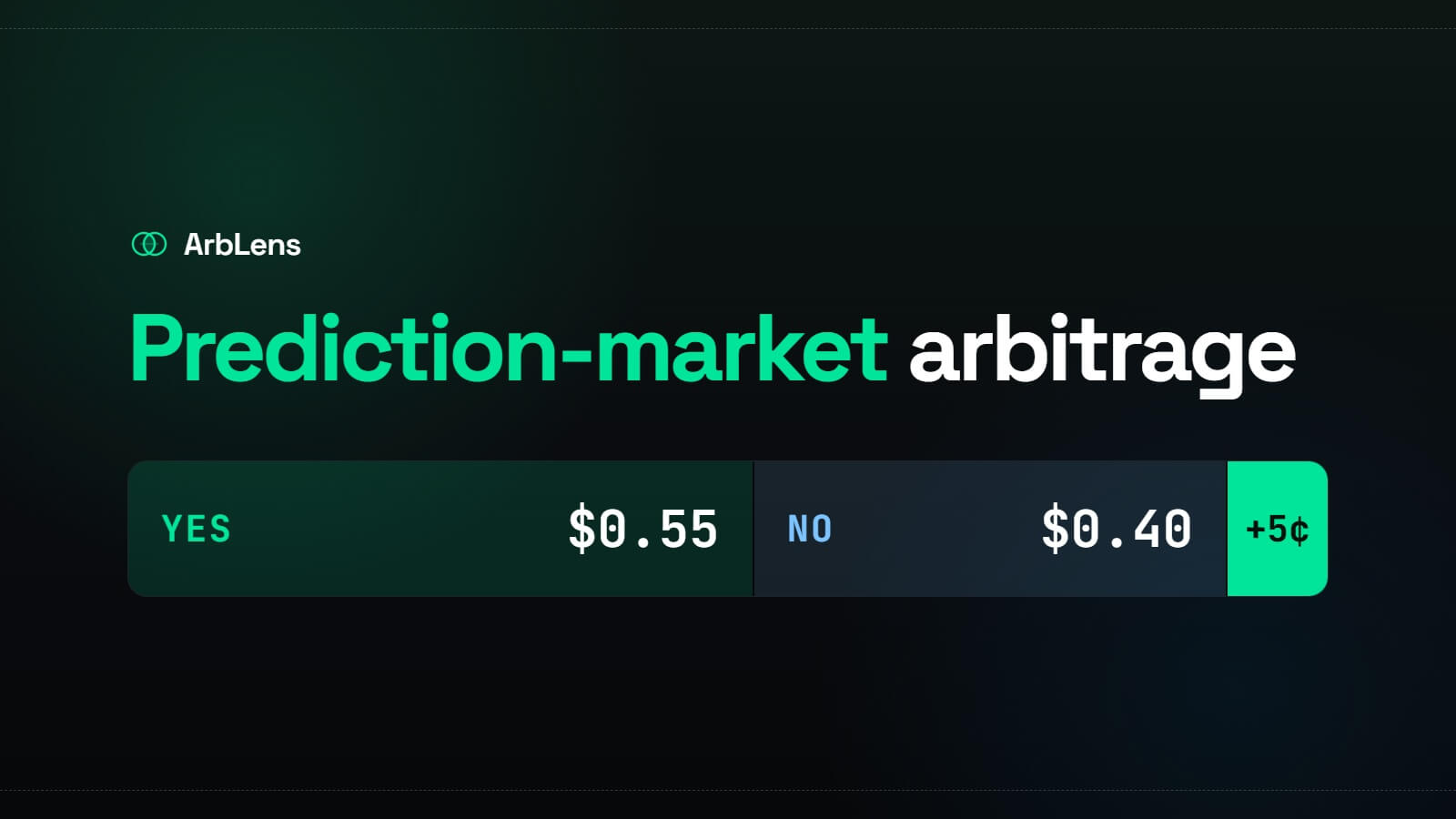
Suppose one platform offers YES at $0.55 while another offers NO on the same event at $0.40.
Buying both costs $0.95. If the contracts are truly complementary and one side pays $1, the gross locked return is $0.05 per matched pair.
That conclusion holds only if:
Both orders fill at the quoted prices
The position sizes match
Both contracts cover exactly the same event
Deadlines and timezones match
Resolution sources are compatible
The platforms cannot reach conflicting valid outcomes
Fees remain below the $0.05 gap
If one platform asks whether an event occurs by December 31 at 11:59 p.m. ET and another uses UTC, the contracts are not identical.
The difference may be small. It is still enough to break the hedge.
YES and NO on one platform
In a complete binary market, one of the two outcomes should eventually pay $1.
If the executable ask prices for YES and NO add up to less than $1, buying both may lock in a gross return. For example, paying $0.48 for YES and $0.49 for NO costs $0.97 for a future $1 payout.
The displayed prices may not be executable, and enough size may not be available on both sides. Fees and settlement time reduce the return.
When YES and NO add up to more than $1, there is no simple buy-both arbitrage. Capturing the difference may require selling or creating outcome shares, which is not available in the same form on every platform.
Read the rules before the price
A one-cent difference is obvious. A one-line difference in the resolution criteria is easier to miss and can be far more expensive.
Before treating two contracts as the same, compare:
Exact question wording
Opening and closing times
Resolution date
Timezone
Named data source
Rules for postponement or cancellation
Dispute process
Treatment of ambiguous outcomes
Prediction-market arbitrage is often contract analysis first and price comparison second.