Nine crypto arbitrage strategies and where the risk hides
Crypto arbitrage goes well beyond spot price gaps. This guide covers nine common setups, from basis and funding trades to DEX-CEX and prediction markets.
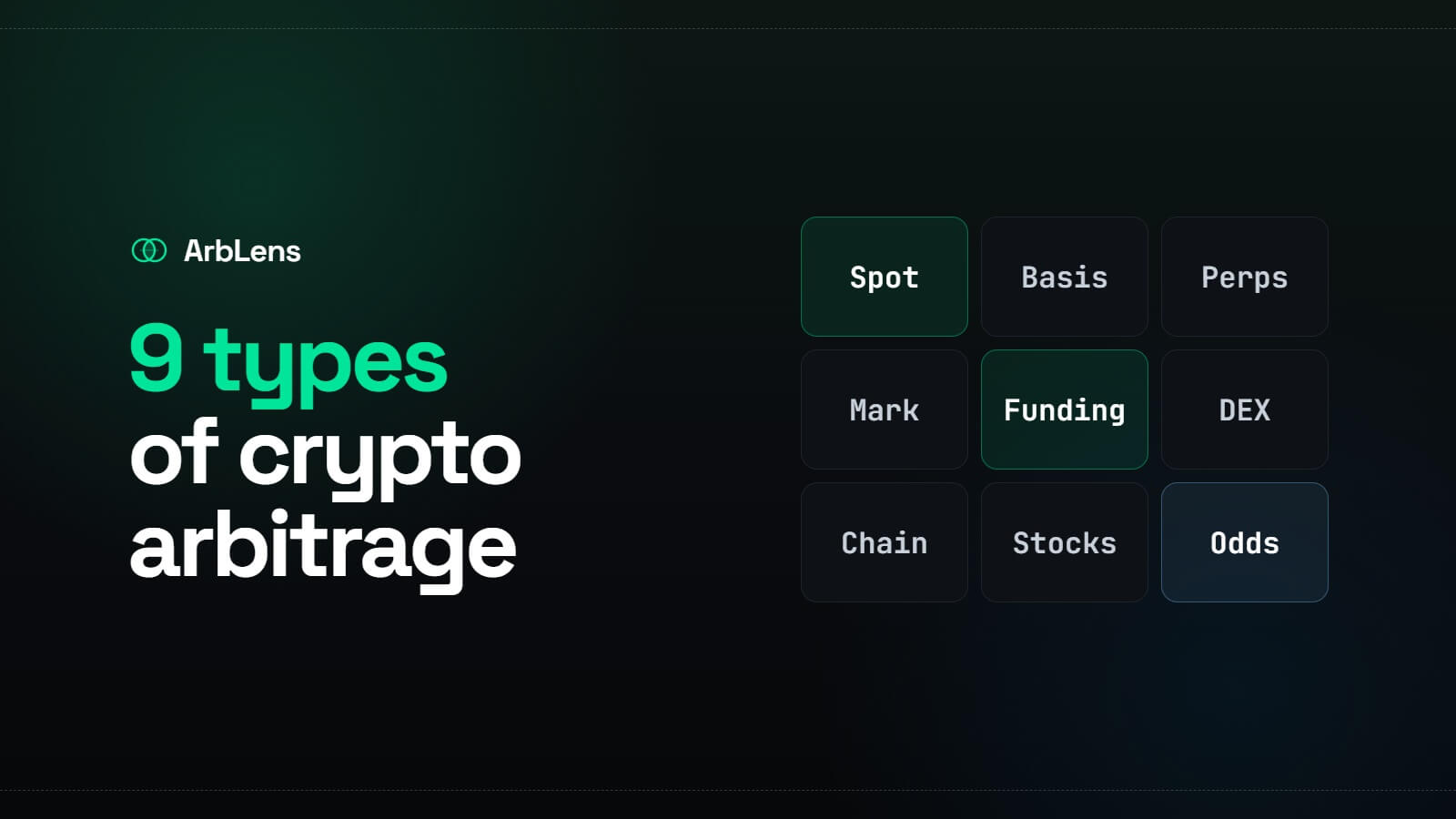
Part 2 of a three-part series on crypto arbitrage.
Excerpt: Crypto arbitrage goes well beyond spot price gaps. This guide covers nine common setups, from basis and funding trades to DEX-CEX and prediction markets.
Crypto arbitrage isn't one strategy. It's a loose group of trades built around the same idea: two related prices have moved apart, and a trader tries to capture the gap.
Some setups are easy to understand but hard to execute quickly. Others look hedged on paper yet still carry funding, liquidity, settlement, or transfer risk. The spread is only the starting point.
Arbitrage on centralized exchanges
Spot-to-spot arbitrage
This is the version most traders learn first. A coin trades cheaper on one exchange and higher on another, so you buy on the first and sell on the second.
Suppose ETH is quoted at $3,450 on Binance and $3,462 on OKX. The gap is $12, or roughly 0.35%.
That 0.35% isn't your profit. Both trades have fees. The order books may move before both legs fill, and the quoted price may not have enough depth for your full order. If funds need to be transferred after the trade, withdrawal costs and delays matter too.
In practice, traders often keep capital on both exchanges. That avoids waiting for a transfer while the spread disappears.
Spot-futures arbitrage
Here the gap is between the spot price and a futures contract on the same asset.
If futures trade above spot, a trader can buy the asset and short the contract in matching size. This locks in the basis, assuming both legs fill as planned and the position remains properly hedged.
The trade still has costs. Spot fees, futures fees, margin requirements, and funding on perpetual contracts can all reduce the return. Leverage adds liquidation risk even when the combined position is close to market-neutral.
Futures arbitrage
The same futures contract can trade at different prices on different exchanges. A trader may go long where it is cheaper and short where it is more expensive.
No coin transfer is needed for each trade. You do, however, need enough margin on both exchanges before the opportunity appears. A profitable spread doesn't help if the short leg is underfunded or gets liquidated during a sharp move.
Contract details also need to match. Two instruments with different expiries, funding rules, or index prices aren't the same trade.
Fair price versus last trade
Some platforms show both a fair or mark price and the price of the latest trade. During a fast market, those numbers can split briefly.
The last price may jump after a thin order book gets hit, while the fair price moves more slowly. Traders can use that gap as a short-term signal.
Still, this isn't a locked spread in the usual sense. The fair price is generally a reference price, not a quote you can trade against. The gap may close before an order fills.
Funding-rate arbitrage
Perpetual futures use funding payments to keep their price near spot. When funding is strongly positive, longs pay shorts. A trader can short the perpetual and hedge the market exposure with a spot purchase or a long position elsewhere.
The aim is to collect funding without taking a large directional bet.
Calling this passive income is a stretch. Funding rates change, sometimes quickly. The hedge can drift, fees can absorb several funding periods, and each leg still needs enough collateral. A high displayed rate is useful only if it lasts long enough to cover the cost of putting the trade on.
DEX and crosschain trades
DEX-CEX arbitrage
A token may trade at one price on a DEX such as Uniswap or PancakeSwap and another on a centralized exchange. The gap can be larger than a typical CEX-to-CEX spread, especially when an on-chain pool is thin.
Execution is less forgiving. Gas costs are known only at the time of the transaction, and a modest trade can move the pool price against you. Slippage limits help, but they can also cause the transaction to fail while the centralized-exchange leg has already filled.
Impermanent loss isn't inherent to the arbitrage itself. It becomes relevant if the trader provides liquidity to the pool rather than simply swapping through it.
Crosschain arbitrage
The same token can trade at different prices on different networks. USDC on Ethereum, for example, may temporarily diverge from USDC on Arbitrum because liquidity is split and moving funds between chains has a cost.
The gap has to cover gas, bridge fees, and the time spent waiting for funds to arrive. There is another detail to check: tokens with the same ticker aren't always issued or backed in exactly the same way on every chain.
Keeping capital on both networks is faster. It also leaves more capital spread across wallets and bridges, which makes rebalancing harder.
Arbitrage outside standard crypto markets
Tokenized-equity arbitrage
Some platforms list products tied to shares such as AAPL or TSLA. A price gap can appear between the tokenized product and the underlying stock.
That gap isn't automatically tradable. The product may have different trading hours, settlement terms, or redemption rules. If the token can't be converted into the underlying share, the prices may remain apart longer than expected.
The contract matters more than the ticker.
Prediction-market arbitrage
Prediction markets such as Polymarket and Kalshi may list contracts that appear to cover the same event. If their prices imply different probabilities, a trader may be able to buy opposing outcomes for less than the combined payout.
The wording has to match. Two contracts can ask similar questions yet use different deadlines, data sources, or resolution rules. In that case, buying both sides doesn't lock in a profit. It creates settlement risk.
The setup changes, but the work is similar
Spot-to-spot arbitrage is the easiest to understand. Futures and funding trades avoid repeated asset transfers, though they require margin on each venue. DEX and crosschain trades add gas, bridge costs, and more execution risk. Prediction markets and tokenized equities bring contract terms into the equation.
Across all of them, the operational problem is the same: capital ends up scattered across exchanges, subaccounts, and wallets. Positions may be hedged as a pair, but each leg lives somewhere else.
ArbLens brings balances, paired positions, funding, PnL, and transfer history from supported exchanges and on-chain wallets into one view. It doesn't find or execute arbitrage trades. It shows what is already open, where the collateral sits, and whether one side of a trade has become unhedged.