Futures arbitrage: trading price gaps across exchanges
Futures arbitrage trades price gaps for matching contracts across exchanges. Learn how spreads form, how to hedge both legs, and where leverage adds risk.
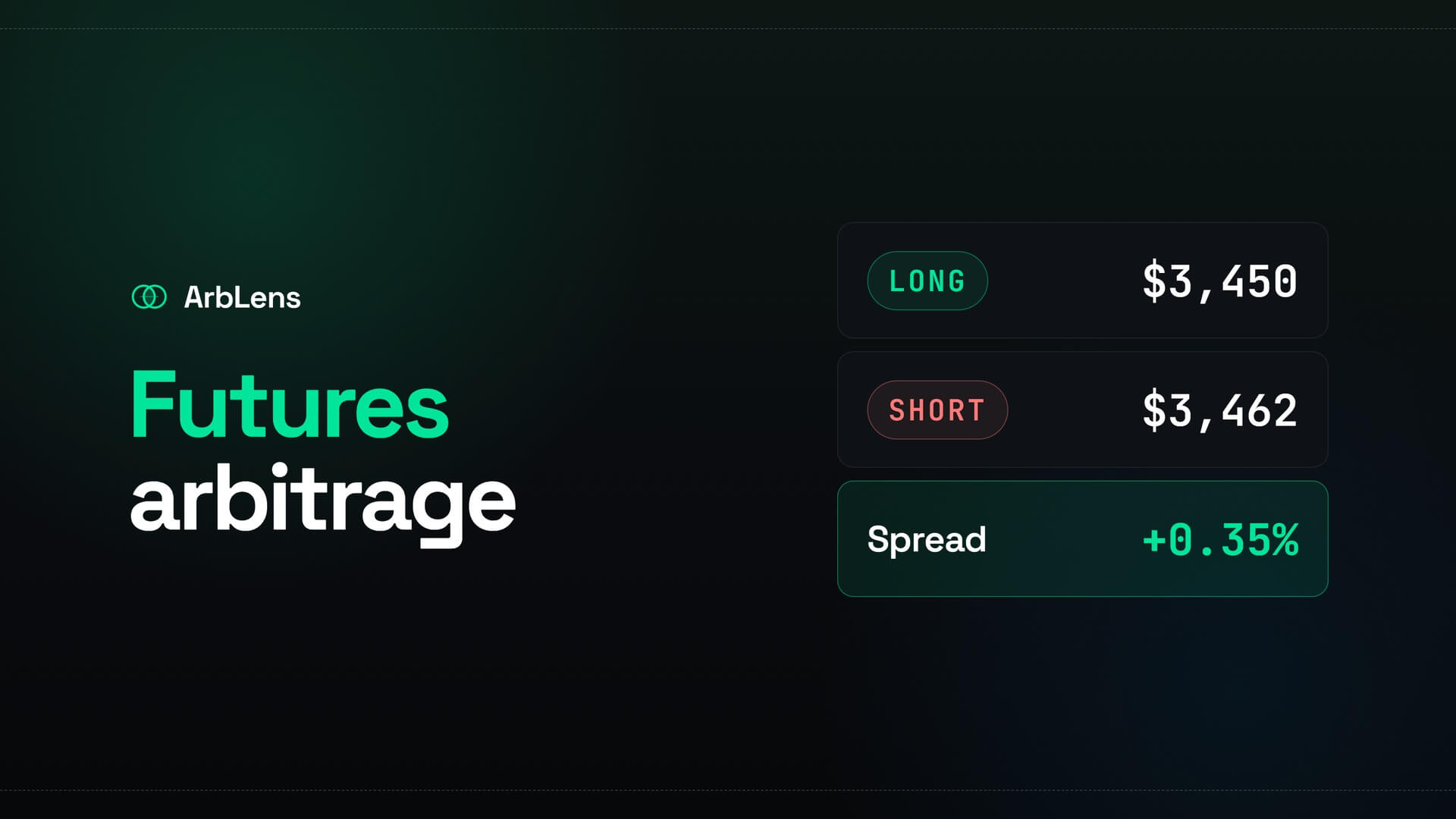
Part 1 of a four-part series on futures arbitrage.
Futures arbitrage targets price gaps between comparable contracts listed on different exchanges. The trade goes long where the contract is cheaper and short where it is more expensive.
The structure resembles spot arbitrage, but both legs use derivatives. That changes the capital requirements and introduces funding, margin, and liquidation risk.
Why futures prices diverge
Each exchange has its own order book. The traders, liquidity, open interest, and positioning on Binance differ from those on Bybit or OKX.
A large order can move the futures price on one venue without producing the same move elsewhere. Liquidations can push it even further. The result is a temporary spread between contracts that track the same underlying asset.
Mark-price and index methodologies may also differ. Those differences matter because exchanges use their own reference prices to calculate unrealized PnL and liquidations.
Make sure the contracts actually match
The same asset ticker doesn't guarantee that two futures contracts are equivalent.
Before comparing prices, check:
Underlying asset
Quote and settlement currency
Perpetual or dated contract
Expiration date
Contract multiplier
Linear or inverse structure
An ETH-USDT perpetual should not be compared directly with an ETH-USD inverse contract or a dated future expiring next quarter. Their prices reflect different collateral, settlement, and funding mechanics.
The closer the specifications match, the cleaner the hedge.
Perpetual and dated futures
Perpetual contracts have no expiration date. Funding payments help keep their prices near the underlying spot market. Major perpetual markets often have deep liquidity, so cross-exchange spreads tend to be small and short-lived.
Dated futures expire on a set date. Quarterly contracts are one common example. Their prices can diverge more because liquidity is often lower and traders may price the basis differently on each venue.
Volatile markets can widen both types of spread. News, large directional orders, and liquidation cascades may push one exchange out of line with the others.
That creates an opportunity. It also makes execution harder.
A basic futures arbitrage trade
Suppose an ETH-USDT perpetual trades at $3,450 on Binance and $3,462 on Bybit.
The $12 difference is roughly 0.35%.
The trade has two legs:
Open a long at $3,450 on the cheaper venue.
Open an equal-sized short at $3,462 on the more expensive venue.
Hold both positions while monitoring the spread and funding.
Close both legs when the gap has narrowed enough to leave a profit after costs.
If both contracts later trade at the same price, the gross result is approximately $12 per ETH of matched exposure. Trading fees, funding, slippage, and execution differences reduce that amount.
The position sizes must match. A long worth 1 ETH and a short worth 0.8 ETH leave 0.2 ETH of directional exposure.
Convergence isn't guaranteed on your schedule
Arbitrageurs and market makers usually pull comparable prices toward each other. "Usually" matters.
The spread can widen before it narrows. It can remain open longer than expected, and perpetual contracts have no expiry forcing them to settle at the same time or price.
Dated futures offer a clearer endpoint, but each exchange may settle against a different index. Even contracts with the same expiry can retain a small difference until settlement.
Futures arbitrage is therefore a convergence trade. It is not a guarantee that both prices will meet immediately.
Both legs need margin in advance
The trade doesn't require moving the underlying coin between exchanges for every position. Instead, collateral must already be available on both venues.
That makes entry and exit faster than waiting for an on-chain transfer. It doesn't remove the need to rebalance. Profits, losses, and funding payments gradually move usable margin from one exchange to the other.
If one account runs low on collateral, the position can be liquidated even while the combined trade remains profitable. Margin can't help the stressed leg if it is sitting on another exchange.
Leverage increases risk, not the spread
Futures allow traders to control a larger position with less collateral. That can increase the return on posted capital.
It does not increase the arbitrage edge.
The price gap remains the same, while liquidation distance becomes smaller. A temporary spread expansion can liquidate one leg before convergence produces the expected profit. Once that happens, the other leg becomes an outright directional position.
Low leverage and excess collateral give the spread more room to move. The aim is to survive until convergence, not to maximize the notional size shown on screen.
Funding can reverse the economics
Each perpetual leg has its own funding rate. You may receive funding on the short while paying it on the long, which helps the trade. The opposite combination turns funding into a cost.
Rates can change while the position is open. A spread that looks profitable at entry may become unattractive after several funding periods.
Calculate the expected result across both venues:
$$\text{Net PnL} = \text{Spread PnL} + \text{Funding received} - \text{Funding paid} - \text{Fees} - \text{Slippage}$$
Use the actual funding schedule and fee tier for each contract.
The main execution risk
The two legs are submitted separately. They are not truly simultaneous.
If the long fills and the short does not, you are left exposed to the market. The same applies when one order fills only in part.
Before entry, decide how long to wait for the second fill and how much price movement you will accept. If the hedge cannot be completed inside those limits, unwind the open leg.
Once several cross-exchange positions are running, monitoring each leg in a separate account becomes an operational risk of its own. ArbLens pairs long and short positions across supported venues and tracks their spread, funding, liquidation distance, and net PnL. It can also flag a position when one leg closes or fills only in part.