Fair vs. last price: what the gap actually means
A gap between fair and last price can flag a stressed futures market, but it isn't locked arbitrage. Learn what the signal shows and where the trade can fail.
Part 2 of a four-part series on futures arbitrage.
A futures platform may show several prices for the same contract. Two of the most important are the fair or mark price and the last traded price.
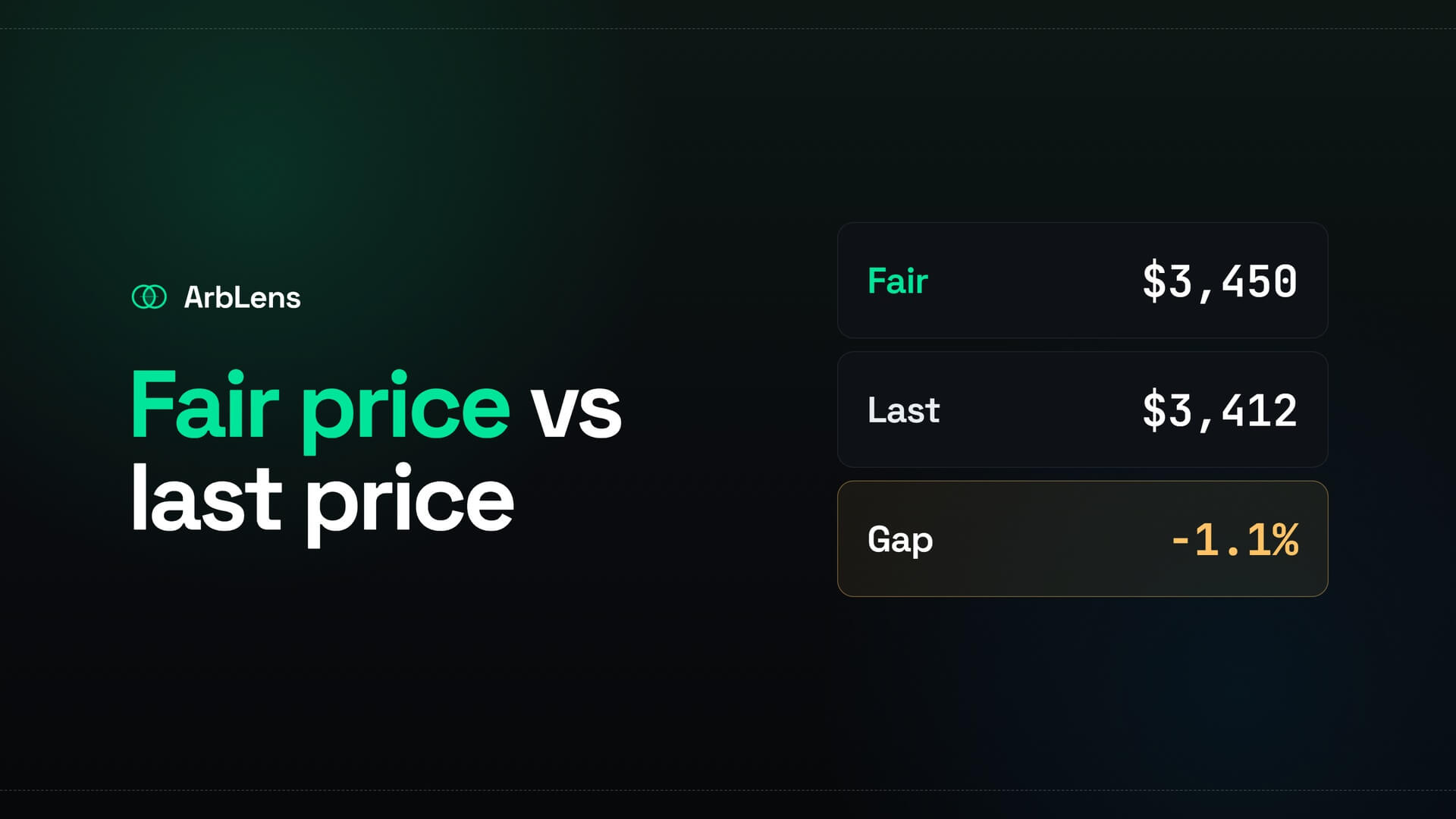
They can move apart during a fast market. That gap may point to an execution opportunity, but it is not locked arbitrage. The fair price is usually a reference value, not a price you can trade against.
What is the fair price?
Terminology varies by exchange. Some platforms use fair price, while others display mark price.
The exchange calculates this reference price to reduce the effect of isolated trades and temporary order-book distortions. The exact formula depends on the venue. It commonly starts with an index price built from spot markets, then applies a basis or funding-related adjustment.
The fair price may be used to calculate unrealized PnL and trigger liquidations. That makes the formula worth checking before trading a contract.
It does not show what the asset "should" be worth in any objective sense. It shows the exchange's current estimate based on its chosen inputs and methodology.
What is the last price?
The last price is simpler. It is the price of the most recent completed trade.
That trade might have been tiny. It might also have been a large market order that moved through several levels of the book. Either way, the number reports one execution rather than the price available for your next order.
A last price of $3,450 does not guarantee that you can buy or sell at $3,450. The current bid and ask may already have moved.
Why the two prices diverge
A large market order can consume the available bids or asks and print far away from the reference price. Thin liquidity makes this easier.
Liquidation cascades can produce a larger move. Forced orders hit the market in one direction, which pushes the last price through the book before other traders restore liquidity.
The gap may also appear because the two prices use different data:
Last price comes from trades on one contract
The index may draw on spot prices from several venues
The fair-price formula may smooth or adjust the index
Each feed updates on its own schedule
The last price can jump while the fair price barely moves. The fair price can also respond to a broader market move before another trade prints locally.
Why this is not risk-free arbitrage
If the last price trades below the fair price, a trader may expect it to recover and open a long. If it trades above, the trader may short.
That is a mean-reversion trade.
There is no second executable leg locking in the gap. You cannot buy at the last price and sell at the fair price because the fair price is not an order in the book. Profit depends on the market moving as expected after entry.
Sometimes it does. Sometimes the gap widens.
A low last price may reflect new information that the index has not absorbed yet. A high last price may be the beginning of a broader move rather than a temporary spike. Treating every deviation as a guaranteed return is a quick way to get trapped.
Check whether the gap is still tradable
Start with the live bid and ask, not the last trade.
If the last price is below fair but the current ask has already returned to fair, the opportunity is gone. The table is showing history. The same applies when the last price is above fair but no bid remains at that level.
Then inspect the book:
Is there enough depth for the intended position?
How far will the average fill move from the top quote?
Did one unusual trade create the entire gap?
Is the index moving toward the last price?
Are liquidations still hitting the market?
A wide gap in a thin book may look attractive while offering almost no executable size.
Liquidation rules matter
Many futures platforms use the mark or fair price rather than the last price to calculate liquidations. This helps prevent one unusual trade from liquidating a large number of positions.
It also changes the risk of the Fair-Last setup.
A contract may print far from the mark without immediately changing the liquidation calculation. But once the mark begins to catch up, margin pressure can rise even if the last price has stopped moving.
Know which price controls liquidation, unrealized PnL, and stop orders on the venue you are trading. They may not all use the same reference.
Speed helps, but it doesn't create an edge
Fair-Last gaps can last only a few seconds. Alerts and live monitoring help traders notice them before the book normalizes.
Fast execution alone is not enough. A trader also needs a rule for deciding which gaps are temporary and which reflect a real market move.
Useful checks include the size of the deviation, current depth, index movement, recent liquidations, and the maximum time allowed for the trade. Position size should be small enough to exit if the expected reversion never happens.
An alert should start the review. It should not place the trade by itself.