Direct vs. cross prediction-market arbitrage
Direct and cross arbitrage pair complementary prediction contracts below a $1 payout. Learn when returns are locked and what can still break the trade.
Part 2 of a four-part series on prediction-market arbitrage.
Prediction-market arbitrage combines complementary contracts whose total purchase price is below their eventual payout.
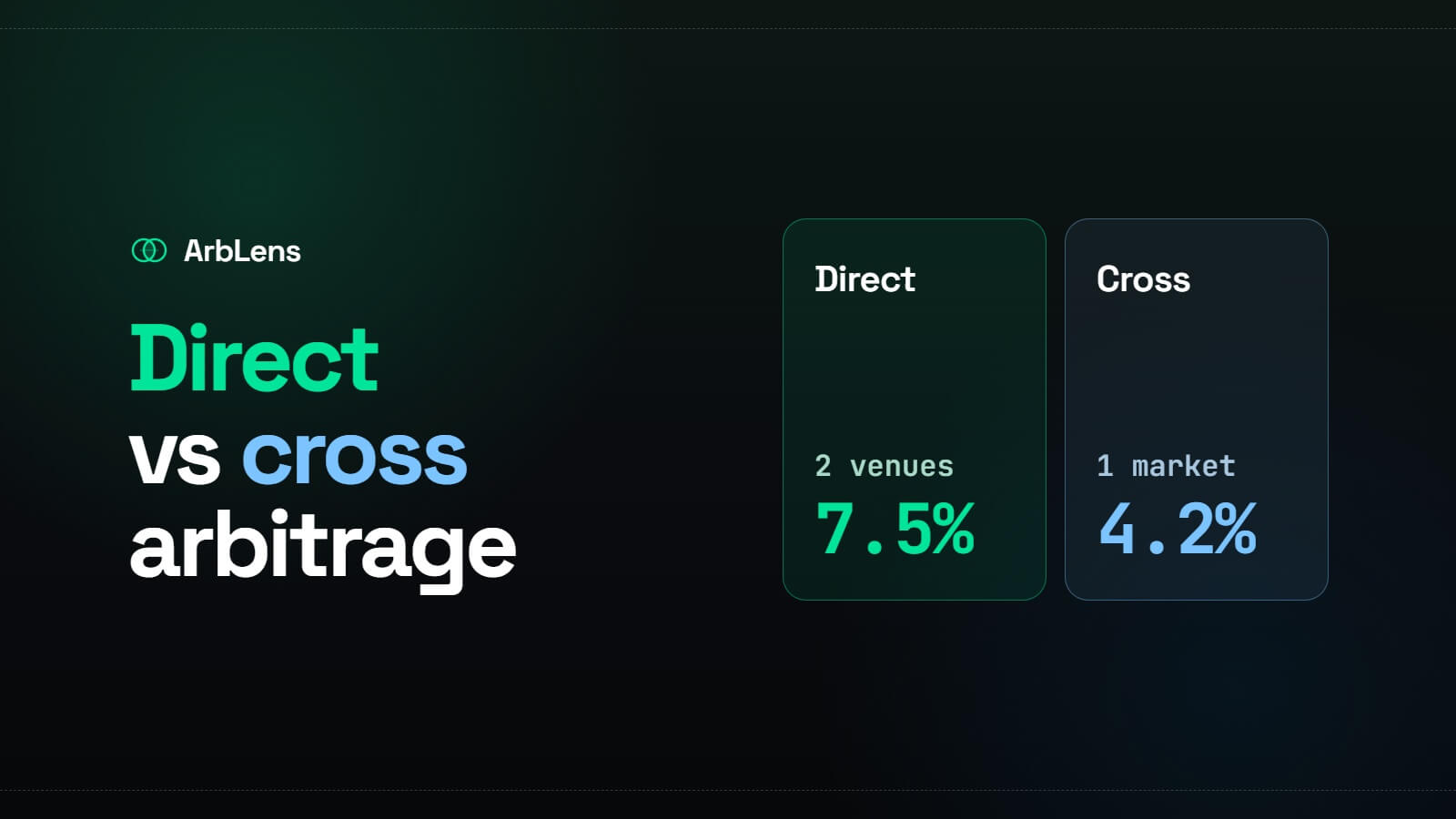
Two common setups are often called direct and cross arbitrage. The terminology is not universal, but the distinction is useful: direct arbitrage uses contracts from different platforms, while cross arbitrage combines outcomes inside one market.
Neither setup is automatically risk-free. The payout becomes direction-independent only after both legs fill and the contracts are confirmed to cover exactly the same outcome.
Direct arbitrage across platforms
Direct arbitrage uses complementary positions listed on separate platforms.
Suppose Polymarket offers YES on Event X at $0.55. Kalshi offers NO on what appears to be the same event at $0.38.
Buying one share of each costs:
$0.55+$0.38=$0.93\$0.55+\$0.38=\$0.93$0.55+$0.38=$0.93
If the event resolves YES on both platforms, the Polymarket contract pays $1 and the Kalshi contract pays nothing.
If it resolves NO on both, the Kalshi contract pays $1 and the Polymarket position pays nothing.
Either way, the combined payout is $1. The gross profit is:
$1−$0.93=$0.07\$1-\$0.93=\$0.07$1−$0.93=$0.07
Return on the $0.93 cost is:
$0.07$0.93×100%=7.53%\frac{\$0.07}{\$0.93}\times100\%=7.53\%$0.93$0.07×100%=7.53%
That is the clean version. It depends on both contracts resolving consistently.
Do not derive NO from a displayed YES price
If a platform shows YES at $0.62, it is tempting to assume that NO can be bought for $0.38.
Check the order book first.
The displayed YES price may be the last trade or a midpoint. The executable NO ask can be different because of the bid-ask spread and available depth.
For the direct example to work, $0.38 must be an actual price at which the required number of NO shares can be bought.
The same rule applies to the $0.55 YES leg. Headline prices do not lock the trade.
The questions must be identical
Two contracts can look the same while resolving under different conditions.
Compare the complete market rules:
Exact event definition
Deadline
Timezone
Resolution source
Treatment of postponements
Cancellation or invalid-market rules
Dispute process
Settlement timing
One platform might ask whether BTC trades above $100,000 before midnight UTC. Another may use New York time or a different price index.
Both contracts could resolve correctly under their own rules and still pay the same side. In that case, the hedge fails.
Cross-platform arbitrage starts with contract review, not price comparison.
Cross arbitrage inside one platform
Cross arbitrage buys complementary outcomes in the same binary market.
Suppose the executable prices are:
YES: $0.52
NO: $0.44
The combined cost is:
$0.52+$0.44=$0.96\$0.52+\$0.44=\$0.96$0.52+$0.44=$0.96
One side should pay $1 after resolution, producing a gross profit of:
$1−$0.96=$0.04\$1-\$0.96=\$0.04$1−$0.96=$0.04
Return on cost is:
$0.04$0.96×100%=4.17%\frac{\$0.04}{\$0.96}\times100\%=4.17\%$0.96$0.04×100%=4.17%
Because both contracts belong to one market, they use the same wording and settlement process. That removes much of the cross-platform resolution risk.
Execution risk remains.
Both orders need to fill
The arbitrage exists only for the matched quantity.
If 1,000 YES shares are available at $0.52 but only 100 NO shares can be bought at $0.44, the locked trade is limited to 100 pairs.
Buying the unmatched 900 YES shares creates a directional position.
The first order may also move or disappear before the second fills. A table can show YES plus NO below $1 without offering enough liquidity to execute both sides.
Use the smaller available size and calculate the average fill across the full order.
Fees can remove the gap
The gross return is the difference between the combined cost and the $1 payout.
Net profit is:
Net profit=$1−YES cost−NO cost−Trading fees−Funding costs\text{Net profit} = \$1 - \text{YES cost} - \text{NO cost} - \text{Trading fees} - \text{Funding costs}Net profit=$1−YES cost−NO cost−Trading fees−Funding costs
Cross-platform trades may add deposit, withdrawal, currency-conversion, or blockchain costs.
Fees do not need to be large to matter. A two-cent gross gap disappears quickly when both legs are charged.
Use the fee schedule for the exact market and account. Some platforms charge only specific contract types or apply fees differently to makers and takers.
Return depends on settlement time
A 7.53% return sounds attractive. It matters whether the market settles tomorrow or six months from now.
Capital used to buy both outcomes remains locked until the contracts are sold or redeemed. If the order books are thin, exiting before resolution may require giving up part of the spread.
For the direct example, investing $1,000 at a cost of $0.93 per matched pair produces a theoretical gross profit of about $75.27.
That assumes fractional sizing, full fills, no fees, and consistent resolution. Position limits and available depth may reduce the executable amount.
Compare opportunities using both ROI and expected holding time.
Direct and cross have different failure modes
Direct arbitrage offers more possible combinations because it compares markets across platforms. The visible gaps may also be wider.
The trade carries more operational risk:
Separate accounts and balances
Different fee structures
Contract mismatches
Different settlement times
Platform-specific cancellation rules
Withdrawal or access restrictions
Cross arbitrage is simpler because both outcomes sit inside one market. The contract rules and payout system are shared.
Its gaps may close quickly. Other traders can see the same complete-set mispricing, and one side may disappear before both orders fill.
There is no reliable rule that direct spreads should be 5–15% or cross spreads 1–5%. The available gap depends on liquidity, contract design, fees, and competition.
What "guaranteed" really means
Buying complementary contracts removes uncertainty about the real-world outcome only when all of the following are true:
Both legs have filled
Quantities match
Combined cost is below the payout
Contracts are truly complementary
Fees are included
Neither market is voided
Both platforms settle and pay as expected
The trade can be outcome-neutral without being risk-free.
Settlement disputes, platform failure, locked withdrawals, partial fills, and mismatched rules can still produce a loss. The word guaranteed should refer only to the payout logic, not the entire trade.