DEX-to-spot arbitrage: execution, gas, and slippage
DEX-to-spot arbitrage trades price gaps between on-chain pools and CEX order books. Learn how gas, slippage, transfers, and execution delays shape returns.
Part 2 of a four-part series on DEX arbitrage.
DEX-to-spot arbitrage trades the price difference between an on-chain liquidity pool and a centralized exchange’s spot market.
The spread can look much wider than a typical CEX-to-CEX gap. It also carries more execution risk. One leg settles through a blockchain transaction; the other fills inside an exchange account.
A basic DEX-to-CEX example
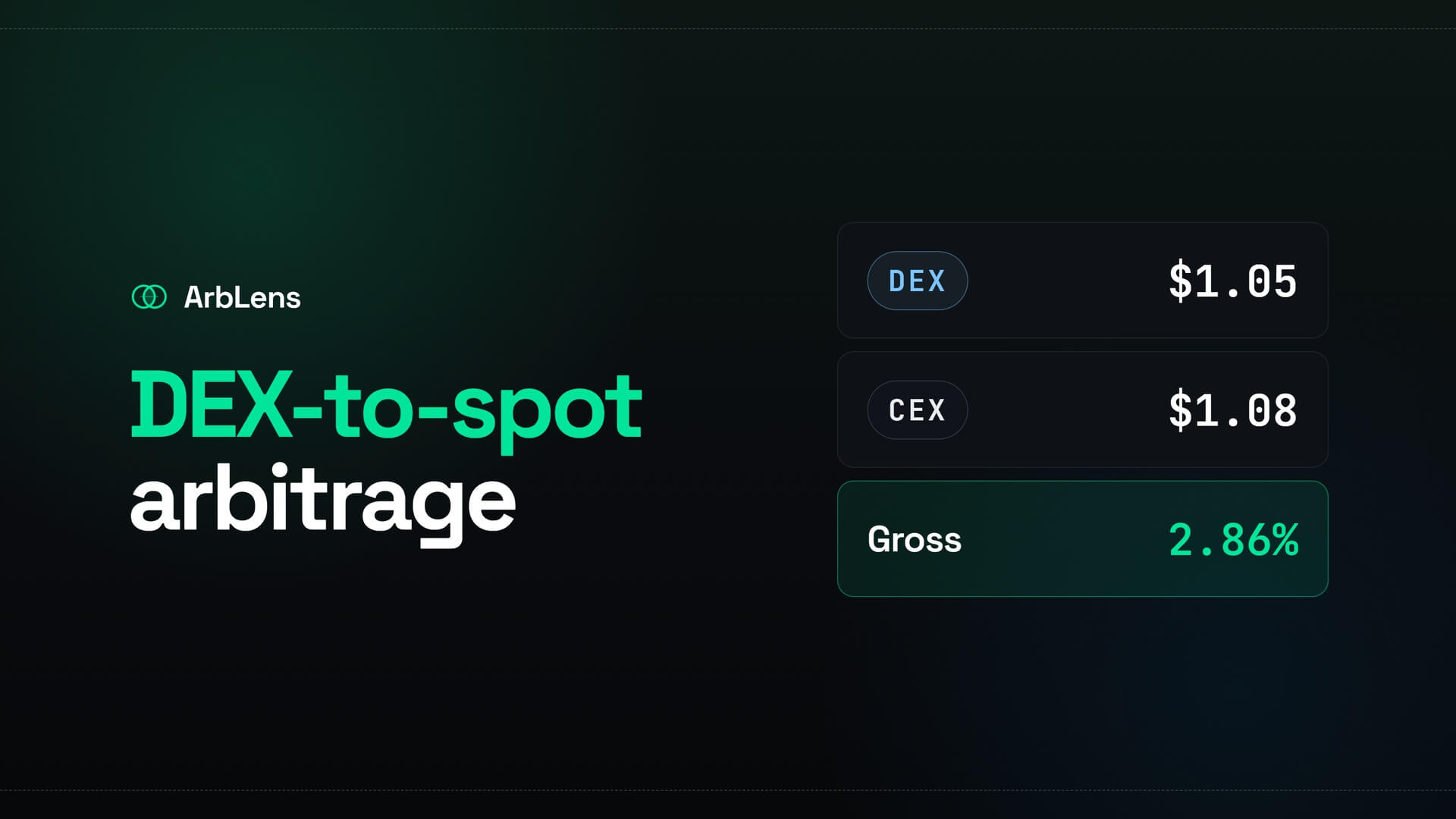
Suppose a token is quoted at $1.05 on Uniswap and the highest bid on Binance is $1.08.
The gross spread is:
$$\frac{\$1.08 - \$1.05}{\$1.05} \times 100\% = 2.86\%$$
In theory, the trader buys the token through Uniswap and sells the same amount on the centralized exchange.
That 2.86% is not the expected return. The DEX quote changes with trade size, while the CEX bid may cover only a limited amount. Gas, swap fees, slippage, and the CEX trading fee all reduce the result.
Two ways to execute the trade
The first method is to buy on the DEX, transfer the tokens to the CEX, and sell them after the deposit arrives.
This requires less capital at the start, but it is slow. The spread may close while the transfer waits for confirmations or the exchange processes the deposit.
The second method uses pre-funded balances:
Keep quote currency in an on-chain wallet
Keep the token inside the CEX account
Buy through the DEX
Sell existing inventory on the CEX at roughly the same time
Rebalance the two sides later
Pre-funding reduces the delay between the trades. It does not make them atomic. The on-chain transaction can fail while the CEX order fills, or the CEX market can move while the swap waits for confirmation.
The reverse trade needs inventory too
If the token is more expensive on the DEX, the direction is reversed: buy on the CEX and sell on-chain.
That still requires capital in the right place. The token must already be available in the wallet if both legs are meant to execute without waiting for a withdrawal.
Sending the token from the CEX after spotting the spread is usually too slow. Withdrawals may also be delayed, suspended, or restricted to a different network.
Wallets and token approvals
A DEX trade requires a compatible wallet. MetaMask is commonly used on Ethereum and EVM networks, while Phantom is widely used on Solana.
The wallet must hold enough of the network’s native token to pay transaction fees. Holding USDC on Ethereum, for example, does not pay gas unless the wallet also has ETH.
The first interaction with a token may require an approval transaction before the swap. That adds another fee and another delay. Unlimited approvals are convenient, but they increase the damage a malicious or compromised contract can cause.
Check the contract and approval target before signing.
Gas has to be measured in dollars
Network fees vary with the chain, transaction type, and current demand for blockspace.
Ethereum mainnet can make a small arbitrage trade uneconomic even when the percentage spread looks attractive. Solana and L2 networks such as Arbitrum or Base often have lower transaction costs, but low gas alone does not make a route profitable.
Compare the gas estimate with the expected dollar profit. A $5 fee is minor on a trade expected to make $200. It destroys a trade expected to make $4.
A reverted transaction may still consume gas.
The DEX quote must match your size
An AMM quote is size-dependent. A pool may show a token price of $1.05 for a small swap but a much higher average price for a larger one.
Price impact comes from your trade changing the pool reserves. Slippage covers the difference between the quoted result and the result available when the transaction executes.
Both matter.
Request a quote for the full intended size. Then compare the expected token output with the amount that can be sold into the live CEX bids. Using a small DEX quote and a large CEX trade size produces a spread that cannot actually be captured.
Read the CEX bid, not the last price
If the plan is to sell on a centralized exchange, the relevant price is the executable bid.
The last traded price may be higher, but no buyer may still be offering that amount. Check how much liquidity sits across the bid levels needed for the full order.
The same rule applies in reverse. When buying on the CEX, use the asks that your order will consume.
The smaller side determines the trade size.
Calculate the net result
A practical estimate is:
$$\begin{aligned} \text{Net PnL} ={}& \text{CEX sale proceeds} - \text{DEX purchase cost} \\ &- \text{DEX swap fee} - \text{CEX trading fee} \\ &- \text{Gas} - \text{Slippage} \\ &- \text{Transfer and rebalancing costs}\end{aligned}$$
If the trade runs in the opposite direction, reverse the buy and sell legs but keep the same cost categories.
Rebalancing costs should not be ignored just because they occur later. A strategy can show profitable fills while gradually losing money whenever inventory is moved back into place.
Confirm that deposits are actually possible
A token with the same ticker can exist through several contracts or on several networks. The CEX may support only one of them.
Before buying on-chain, verify:
The exact token contract
The network accepted by the CEX
Deposit status
Minimum deposit amount
Required confirmations
Transfer taxes or restrictions
Whether a memo or tag is required
Buying the wrong version can leave you with a token the exchange will not credit.
Speed matters after the checks are done
The market does not wait for manual research. Still, skipping the checks turns a fast trade into a blind one.
Prepare wallet balances, token approvals, deposit details, and CEX inventory before monitoring spreads. When a gap appears, the remaining decisions should be limited to trade size, available depth, and net profit after costs.
A spread scanner can show where prices differ. It cannot guarantee that both legs will fill.
ArbLens tracks balances across supported centralized exchanges and on-chain wallets, along with deposits, withdrawals, and transfer history. It does not calculate DEX slippage or execute the trade. It shows whether the inventory needed on each side is already available.