DEX-to-futures arbitrage: hedging on-chain spot with a CEX short
DEX-to-futures arbitrage pairs an on-chain spot buy with a CEX futures short. Learn how basis, funding, margin, gas, and pool depth affect real returns.
Part 3 of a four-part series on DEX arbitrage.
DEX-to-futures arbitrage trades the gap between a token’s on-chain price and the price of a futures contract on a centralized exchange.
The standard position buys the token through a DEX and shorts an equal amount through futures. A broad market move should affect the two legs in opposite directions. Profit depends on the basis narrowing.
That is the theory. In practice, the spot asset sits in a wallet while the short uses margin on a separate venue. The hedge is split across two systems that cannot share collateral.
A basic DEX-to-futures trade
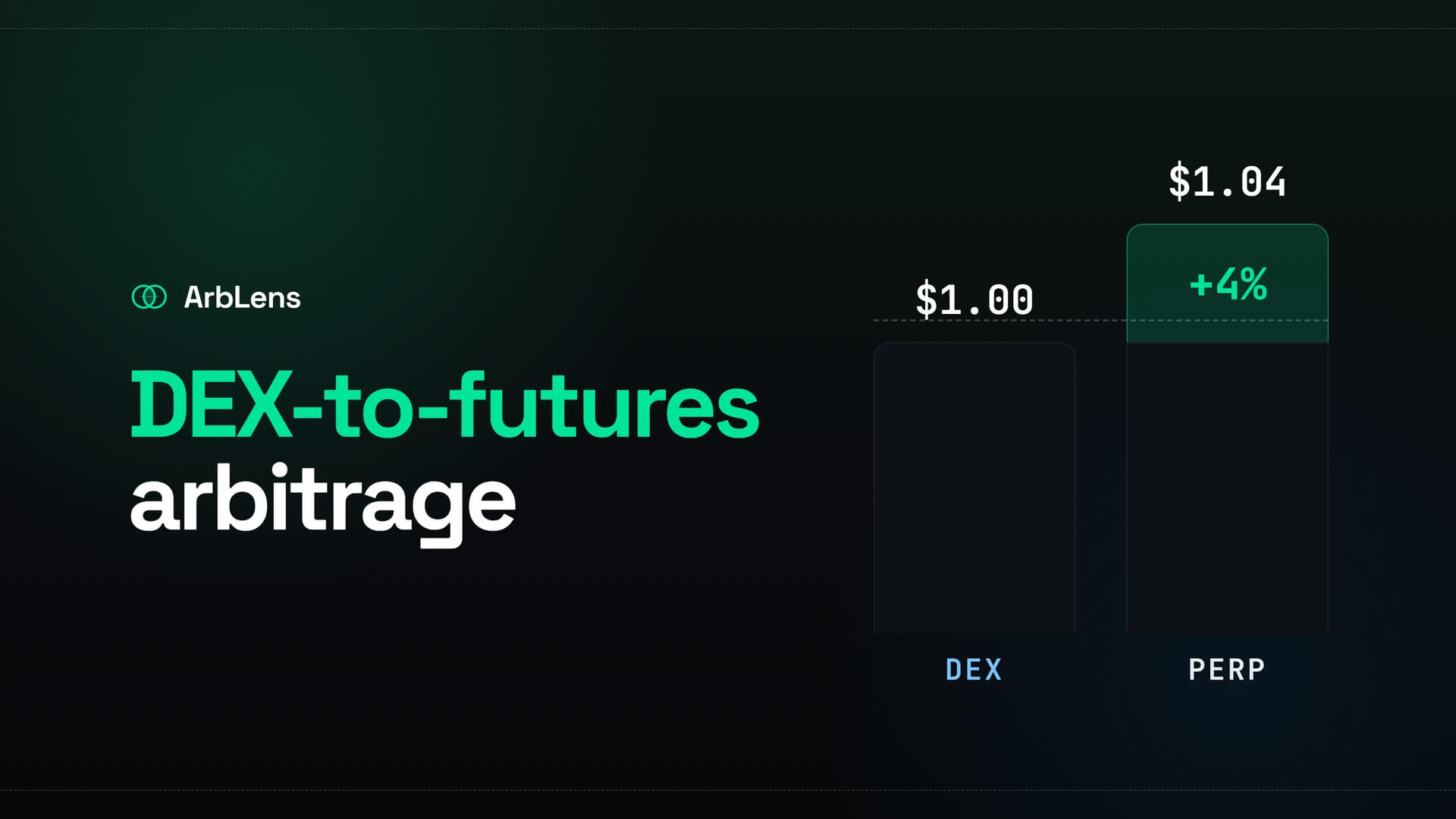
Suppose a token is quoted at $1.00 in an on-chain pool. Its perpetual contract trades at $1.04 on Binance.
The basis is:
$$\frac{\$1.04 - \$1.00}{\$1.00} \times 100\% = 4\%$$
The trade has two legs:
Buy the token through the DEX at about $1.00.
Short the same amount through the futures contract at about $1.04.
Hold both positions while monitoring the basis, funding, and margin.
Sell the spot tokens and close the short when the gap has narrowed.
If both prices converge and the position sizes match, the gross basis capture is approximately $0.04 per token.
Fees and execution costs reduce that amount.
Why the two prices diverge
The DEX and the futures market use different sources of liquidity.
The on-chain price comes from a liquidity pool or routed swap. A large transaction can move that price sharply when the pool is thin.
The futures price comes from bids and asks on the CEX. It also reflects leverage demand, expected funding, and positioning among derivatives traders.
During a fast market, the futures contract may react before the on-chain pool. The reverse can happen after a large swap moves the DEX while the futures order book barely changes.
These gaps can be wider than DEX-to-spot spreads. They are not always easier to trade.
Check that the assets actually match
The DEX token and futures contract must represent the same economic exposure.
A token on-chain may be bridged, wrapped, or issued through a different contract. A futures contract may settle against an index built from markets that do not include the DEX being traded.
Matching tickers are not enough. Check:
Token contract address
Network and token issuer
Futures underlying and settlement currency
Contract multiplier
Index and mark-price methodology
Whether the on-chain token can diverge from the indexed asset
If a wrapped token loses its peg, the futures short may not hedge it properly.
Match the position sizes
Buying 10,000 tokens on the DEX and shorting futures worth 8,000 tokens leaves a net long position of 2,000 tokens.
The hedge should be based on notional exposure:
$$\text{Spot quantity} \times \text{Spot price} \approx \text{Futures quantity} \times \text{Futures price}$$
Some contracts use token quantity, while others use a fixed contract multiplier. Inverse contracts require extra care because their exposure changes with price.
The hedge may also drift while the position is open. Check it again after large price moves or partial fills.
The legs cannot execute atomically
The DEX swap and CEX short are separate transactions.
The futures order may fill while the on-chain swap remains pending. The swap may revert after the short has opened. Either event leaves a directional position.
Choosing which leg to submit first does not remove this risk. It only changes which exposure appears if the second leg fails.
Before entry, define:
Maximum time allowed between fills
Acceptable difference in executed notional
Maximum slippage on the DEX
Price limit for the futures order
How the completed leg will be unwound if the hedge fails
A 4% displayed basis offers no protection if one side moves 6% before the second leg fills.
Margin stays on the CEX
The short requires collateral in the futures account. The spot tokens in an on-chain wallet do not support that margin.
If the token price rises, the wallet position gains value while the futures short loses. The combined trade may remain hedged, but the CEX sees only the losing short.
Without enough margin, that leg can be liquidated before the basis narrows.
Leverage makes the problem worse. It raises the notional exposure relative to collateral without increasing the basis being captured. Keep enough reserve on the CEX to withstand both a market move and temporary basis expansion.
Funding changes the return
A perpetual short may receive or pay funding.
Positive funding usually means longs pay shorts, which adds income to the position. Negative funding means shorts pay longs, reducing the expected return.
Funding is often settled at regular intervals, but the schedule varies by contract and venue. The displayed rate may also change before payment.
A wide basis can take time to close. Several adverse funding periods may absorb much of it.
For dated futures, there is no perpetual funding payment, but the contract has an expiry and its own settlement rules.
Pool depth controls the real entry
The DEX price shown for a small quote may not apply to the full position.
A larger swap moves through the pool curve and receives a worse average price. That reduces the basis before the trade even begins.
Exit depth matters too. When the basis narrows, the spot tokens still need to be sold through an on-chain pool. Liquidity may be worse than it was at entry.
Estimate both swaps at the intended size:
Expected token output when entering
Price impact
Swap fee
Gas cost
Expected proceeds when exiting
Do not calculate the trade from a small headline quote.
Calculate the net basis
A practical estimate includes both sides of the position:
$$\begin{aligned} \text{Net PnL} ={}& \text{Spot PnL} + \text{Futures PnL} \\ &+ \text{Funding received} - \text{Funding paid} \\ &- \text{DEX fees and gas} - \text{CEX fees} \\ &- \text{Slippage} \end{aligned}$$
Capital efficiency should be measured against the money used on both sides: the on-chain spot purchase, futures margin, and liquidation reserve.
A high basis can still produce a poor return if most of the capital remains idle as protection against liquidation.
Closing the position
Both legs should be closed within a defined window.
Selling the spot tokens first leaves the futures short exposed. Closing the short first leaves an unhedged spot position. The same execution plan used at entry is needed again at exit.
Closing may make sense when the basis reaches the target, funding turns adverse, or margin risk rises. Waiting for complete convergence is not always worth the extra time.
ArbLens brings supported on-chain wallet balances and CEX positions into one dashboard, alongside funding, PnL, and liquidation data. It does not scan DEX prices or execute either leg. It shows the capital and exposure already held on each side.